
On this page, I explain how I perform bicycle radar tests so you get a better idea of the details. Each category’s results contribute to my overall verdict on the bicycle radar’s quality, which looks as follows:
Reliability 3/5 | Multi-object Detection 5/5 | Battery Life 3/5 | Mount 3/5 | Brightness 4/5 | Side Visibility 2/5 | App 3/5 | Price 2/5 | WEIGHTED OVERALL SCORE 3.7/5
Scores 1–2.5 are RED, 2.6–3.9 are ORANGE, and 4–5 are GREEN.
I score the following criteria on a scale mainly based on my experience with bicycle radars. The scores are weighted1, meaning each feature has a different importance. For example, reliability has greater weight than the app’s capabilities.
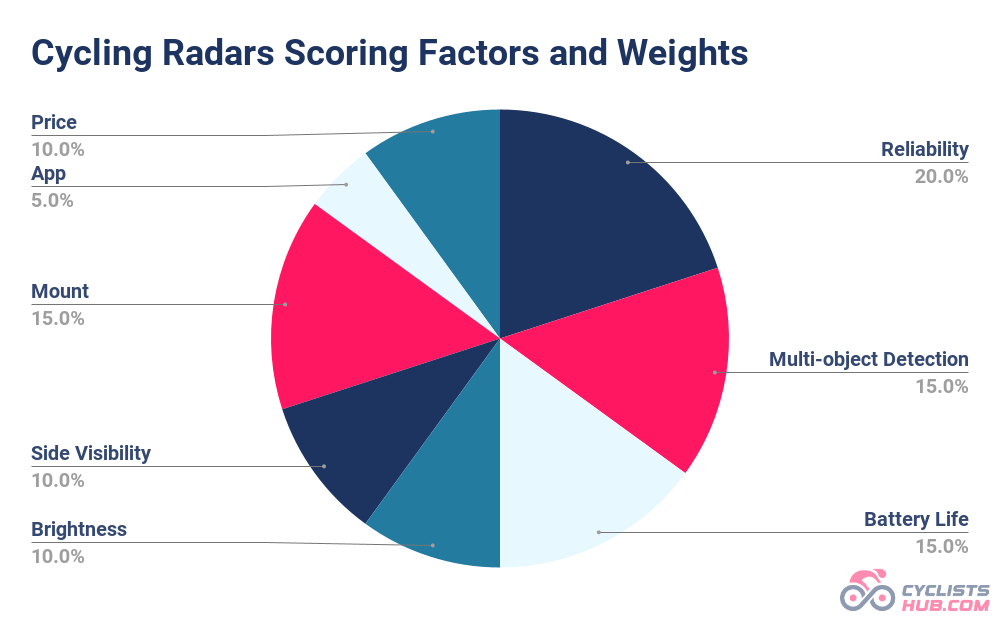
Scoring Criteria for Bicycle Radar Features
Below is a list of bicycle radar features, along with an explanation of the scoring.
Reliability
The reliability of a radar means, first and foremost, whether it gives false negatives or not. A false negative means the radar fails in its basic function of detecting an object, which can lead to fatal consequences. Therefore, I give this radar a single point for reliability, and the review concludes that I do not recommend it for purchase.
The scale from 2-5 is then characterized by varying degrees of false positives (the radar warns of a non-existent object). While testing different radars, I have noticed that results vary across brands. Especially in the early stages after launch, when the manufacturer has limited data and customer feedback, the radar can produce many false positives, which are annoying but not a dealbreaker.
However, this can be improved through firmware updates, which many manufacturers release to enhance their radar performance. For now, the best-tuned radars are Garmin Varia radars.
The reliability scoring is as follows:
- 1 – The radar gives one or multiple false negatives during testing.
- 2 – The radar gives many false positives (e.g., more than 5 per hour of riding).
- 3 – The radar gives multiple false positives (e.g., 3 per hour of riding).
- 4 – The radar gives a few false positives (e.g., 1 per hour of riding).
- 5 – The radar gives almost no false positives (1-3 per 5-hour ride).
Multi-object Detection
Multi-object detection is the radar’s ability to accurately detect and track multiple objects at once. This is a feature useful, for example, in heavy traffic. Most radars today claim to be able to detect 5 or more vehicles, but practice is often different.
I’ve noticed that radars differ in how many objects they can detect at once and how accurately they display them on the bike computer (or phone). Again, the Varia radars are among the most accurate.
- 1 – The radar can only detect one object.
- 2 – The radar can detect and track up to 3 objects, but it is inconsistent.
- 3 – The radar can detect and track up to 3 objects and is relatively consistent.
- 4 – The radar can detect and track more than 3 objects and is relatively consistent.
- 5 – The radar can accurately detect and track 5 or more objects.
Battery Life
Battery life is relatively easy to assess because it is measurable. My test includes setting the radar to its fast-flash mode and riding multiple rides until the battery dies.
Battery life may be affected by the outside temperature. So, if I test the radar at lower temperatures or if other features, like the camera recording, are turned on, it is mentioned in the review.
The scoring is as follows. It’s based on the real battery life, not the claimed one.
- 1 – Below 5 hours.
- 2 – [5-10) hours.
- 3 – [10-15) hours.
- 4 – [15-20) hours.
- 5 – Above 20 hours.
Mount
Mount scoring includes the mount’s ability to hold the radar firmly in place and its overall design. This means its compatibility with multiple seatposts shapes and ease of installation.
My experience with many cycling radars is that their mounts tend to slide on certain types of seatposts and require adjusting during the ride.


Mounts attached with rubber bands are easy to install, but not too firm. On the other hand, the Tutuloo radar mount is firmer but bulky and impractical. Another example is the mount of the Varia RCT715 radar, which is firm and secure but bulky. The best mount is currently the one of Bryton Gardia R300L.
- 1 – E.g., a loose mount compatible with only one seatpost type or an impractical mount.
- 2
- 3
- 4
- 5 – E.g., a firm and practical mount compatible with multiple seatpost types.
Brightness
The luminosity of the radar improves the visibility of the cyclist and, therefore, their safety on the roads. Luminosity often varies across modes. For example, a solid mode is not as bright as a quick flash. This would negatively affect battery life.
Some radars, such as the Magene L508, allow increasing brightness at the expense of the battery. However, I count on the default brightness to preserve objectivity because the claimed battery life is given for default, not maximum brightness.
Since I don’t have a lux meter yet, I rely on the manufacturers’ specifications. The scale is as follows:
- 1 – Below 5 lumens in solid mode.
- 2 – [5-10) lumens in solid mode.
- 3 – [10-15) lumens in solid mode.
- 4 – [15-20) lumens in solid mode.
- 5 – Above 20 lumens in solid mode.
Side Visibility
At first, I didn’t pay too much attention to this feature. But the more radars I tested, the more I started noticing the nuances. Side visibility varies among cycling radars: some have side LEDs, while others don’t.
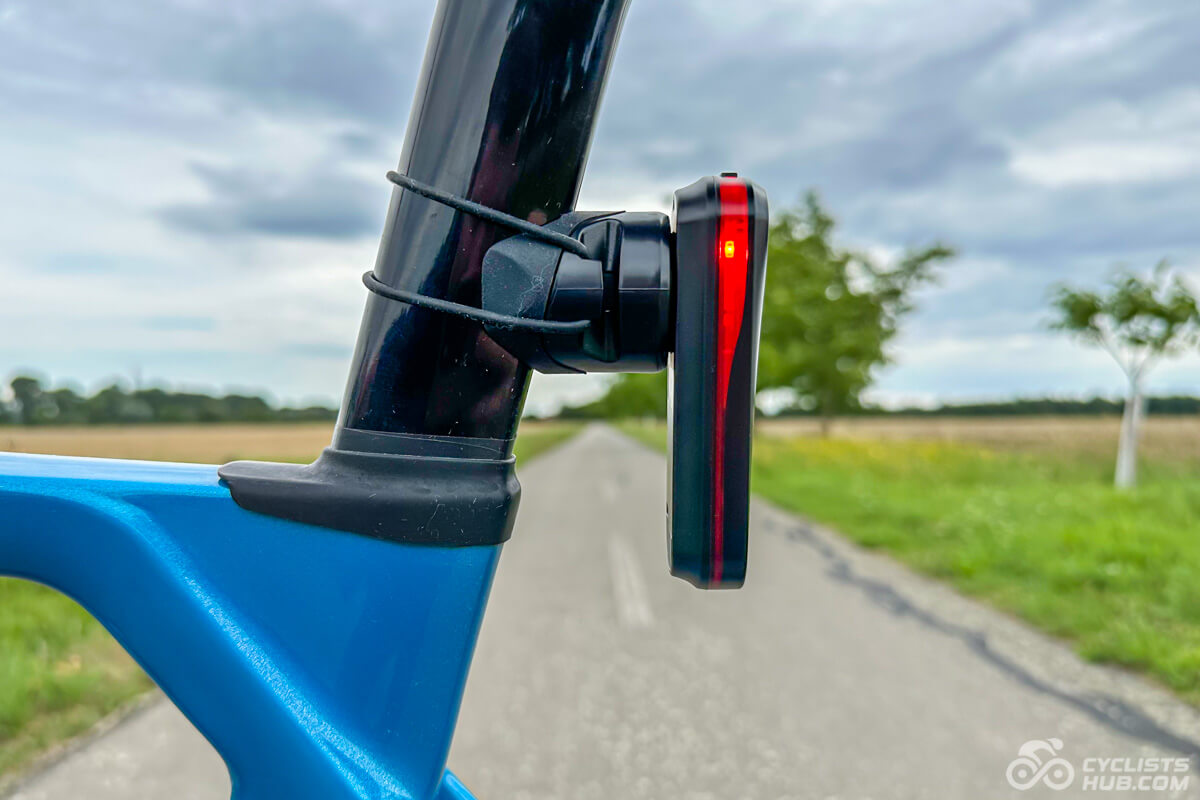


The side visibility further improves your safety, especially in low-light scenarios. Therefore, I also include it in the evaluation.
- 1 – E.g., the radar doesn’t improve side visibility.
- 2
- 3
- 4
- 5 – E.g., the radar significantly improves side visibility.
App
The application includes evaluating several things. The most important one is its ability to replace the bike computer. That is, can the radar be used only with a phone? Then, I also look at the possibility of customizing light modes and firmware updates, its design and user-friendliness, and connection reliability.


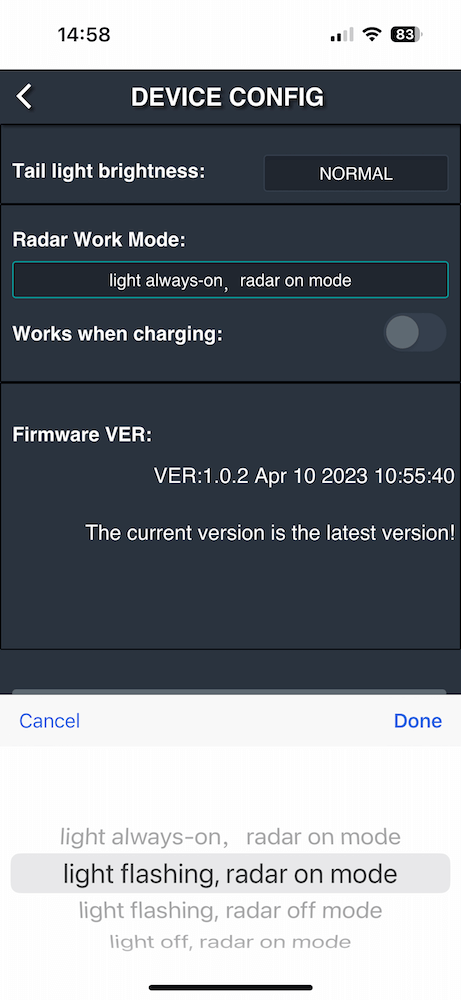
Here, the overall rating varies a bit. I add a point for each condition fulfilled (a maximum of 5 points).
- The app can replace the bike computer – 1 point.
- The app allows additional radar settings – 1 point.
- The application allows firmware updates – 1 point.
- The application is intuitive and has a modern design – 1 point.
- The app is reliable and connects seamlessly to the radar – 1 point.
This results in the following score:
- 1 2 3 4 5
Price
I also included the recommended retail price (RRP) in the evaluation, although its perception is highly subjective.
But the truth is that the price of radars varies greatly, and some can be several times more expensive than others. The evaluation is as follows:
- 1 – Above $250.
- 2 – Between $249.99 and $200.
- 3 – Between $199.99 and $150.
- 4 – Between $149.99 and $100.
- 5 – Below $100.
Camera
There is currently only one bicycle radar with a camera, the Garmin Varia RCT715. I currently don’t include the camera functionality in the scoring. However, if there are more radars with cameras, I will consider adding the camera feature as a separate category.

Maximum Detection Speed
Radars also differ in the maximum relative speed they can detect (e.g., up to 160 km/h [99.4mph]. I haven’t included this feature directly in the evaluation yet, but I do take it into account for reliability. I also comment on it in the reviews.
Conclusion
I hope you now have a better idea of how I review bicycle radars. I aim to share my experience with potential buyers and help you make informed buying decisions.
Please remember that I am still tweaking and improving this process to provide you with the most valuable information possible.
I am open to suggestions on how to improve. Feel free to contact me. Here is the list of all the bicycle radars I reviewed:
Recent Updates
- Dec 13, 2023: V1.0 testing procedure introduced.
- I surveyed cyclists to find out what features they look for in bike radars and how they rate their importance. ↩︎