
On this page, I explain how I score gravel bikes so you get a better idea of the details. Each category’s results contribute to my overall verdict on the gravel bike’s quality, which looks as follows:
Comfort 4/5 | Handling 5/5 | Components 5/5 | Build Quality 4/5 | Accessories Compatibility 2/5 | Weight 2/5 | Design 4/5 | WEIGHTED OVERALL SCORE 4.0/5
Scores 1–2.5 are RED, 2.6–3.9 are ORANGE, and 4–5 are GREEN.
I score the following criteria on a scale from 1-5 based on in-depth market research, which includes evaluating my and other owners’ experiences and comparing the bike’s components with competing alternatives. The scores are weighted, meaning each feature has a different importance. For example, the handling is more important than the design.
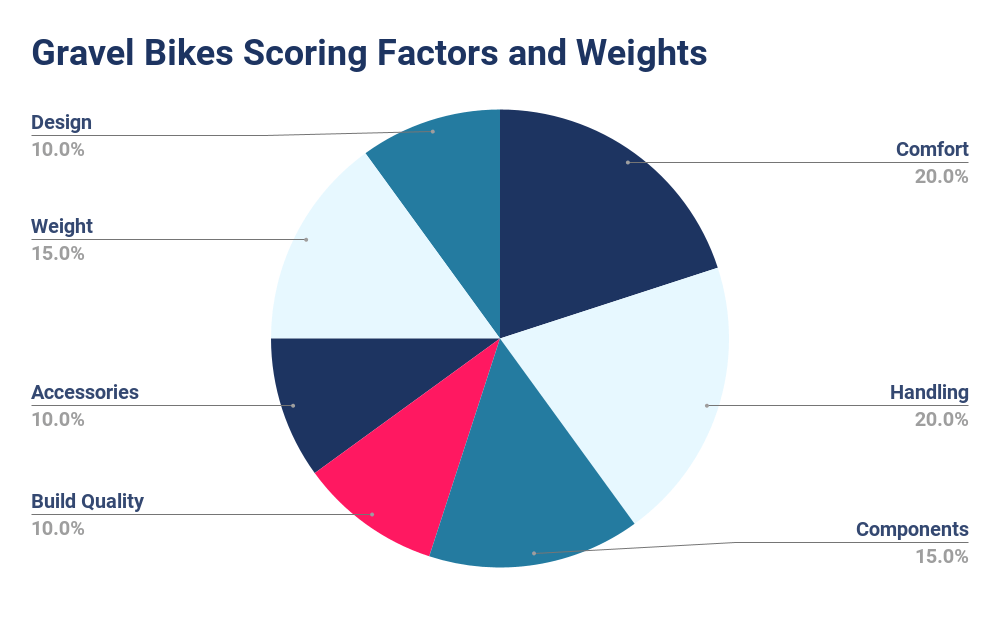
I approach each bike as objectively as possible. However, like everyone, I am subject to biases and expectations.
Scoring Criteria for Gravel Bike Features
Below is the list of the features of gravel bikes with an explanation of the scoring.
Comfort
Riding comfort on bikes is mainly influenced by three characteristics. The first is geometry. An upright geometry is suitable for more casual riders and those who want to do long rides or bike packing. At the same time, it does not strain the back as much.
Next, I look at the maximum tire clearance and the tire width the bike comes with. The wider the tires, the better they can absorb bumps, contributing to better riding comfort.
The last factor affecting comfort is the suspension. Gravel bikes generally have no suspension. However, there are models with front suspension or even rear suspension. Although they add weight, they improve riding comfort and make the bike more suitable for MTB-like terrain.
- 1 – E.g., the bike is rigid, has a sporty geometry, and comes with narrow tires.
- 2
- 3
- 4
- 5 – E.g., the bike has wide tire clearance and relaxed geometry.
Handling
Handling is mainly influenced by bike geometry (wheelbase, head angle, etc.), wheel size (650b vs. 700c), and other factors. In my experience, highly maneuverable and agile bikes tend to have steeper head angles, smaller wheels, and shorter stems. It’s important to note that increased maneuverability often comes at the cost of stability.
- 1 – E.g., the bike has bad maneuverability and is unstable.
- 2
- 3
- 4
- 5 – E.g., the bike is easily maneuverable but less stable.
Components
When it comes to components, I mainly look at what components the gravel bike is equipped with. In particular, the frame, groupset (drivetrain, brakes, derailleurs), and wheels. For the frame, I look at what material it is made of and what its other characteristics are (quality of workmanship, weight, etc.).
For a groupset, I evaluate what kind of groupset it is, whether it is mechanical or electronic, or whether it is a combination of different groupsets. I simplify the evaluation of the wheels to whether they are aluminum or carbon and what reviews are available about them.
- 1 – E.g., the bike has low-quality components.
- 2
- 3
- 4
- 5 – E.g., the bike has high-quality components.
Build Quality
When evaluating build quality, I look at photos of details, especially welds, as well as reviews from other customers and their longer-term experiences. For some bikes, build quality only becomes apparent in the longer term, in which case longer-term reviews and the experiences of others are irreplaceable.
- 1 – E.g., the bike has serious manufacturing defects.
- 2
- 3
- 4
- 5 – E.g., the bike is built with attention to detail.
Accessories Compatibility
Accessories compatibility means whether the gravel bike has additional mounts for bottles, bags, fenders, etc. They can be on the front fork or frame. This feature might not be as important for everybody, so it has a lower weight.
- 1 – E.g., the bike has no additional mounts for accessories.
- 2
- 3
- 4
- 5 – E.g., the bike has multiple additional mounting points and, eventually, comes with accessories.
Overall Weight
Nobody likes heavy bikes. That’s why the overall weight is part of this scoring as well. Remember, the more accessories and features like the front suspension, the higher the weight!
- 1 – 11kg and more
- 2 – [10-11kg)
- 3 – [9-10kg)
- 4 – [8-9kg)
- 5 – Below 8kg
Design
Design is highly subjective, but I have to like the bike I ride. That’s why I’ve included it to a small extent. I look primarily at how the bike feels to me as a whole, whether the manufacturer pays attention to detail, whether the cable routing is hidden, etc.
- 1 – Old-looking bike without too much effort from designers.
- 2
- 3
- 4
- 5 – Modern-looking bike designed with an attention to detail.
Conclusion
I hope you now have a better idea of how I review gravel bikes. I aim to help buyers like you make educated buying decisions.
Please remember that I am still tweaking and improving this process to provide you with the most valuable information possible.
I am open to feedback on how to improve this system. Feel free to contact me with suggestions.
Recent Updates
- Jan 11, 2024: V1.0 scoring introduced.