
On this page, I explain how I test and score cycling rocker plates so you get a better idea of the details. Each category’s results contribute to my overall verdict on the cycling rocker plate’s quality.
I evaluate them on a scale of 1-5, where 1 is the worst and 5 is the best. It looks as follows:
Motion 3/5 | Adjustability 1/5 | Compatibility 5/5 | Ease of Setup 4/5 | Build Quality 5/5 | Price 1/5 | WEIGHTED OVERALL SCORE 3.1/5
Scores 1–2.5 are RED, 2.6–3.9 are ORANGE, and 4–5 are GREEN.
I score the following criteria on a scale mainly based on in-depth market research, which includes evaluating my and other owners’ experiences and comparing the rocker plate features with competing alternatives. The scores are weighted, meaning each feature has a different importance. For example, the accuracy is more important than the battery life.
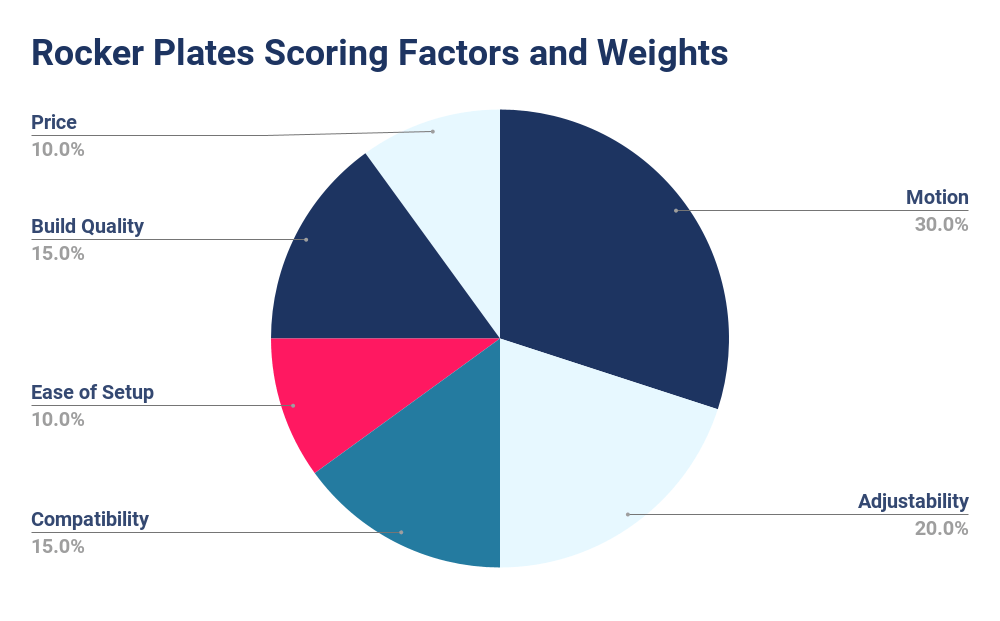
I approach each rocker plate as objectively as possible. However, like everyone, I am subject to biases and expectations.
Scoring Criteria for Rocker Plate Features
Below is the list of the features of cycling rocker plates with an explanation of the scoring.
Motion
In terms of movement, I particularly assess whether the rocker plate offers fore-aft and lateral movement, as well as the extent to which it does so. Side-to-side tilt is present on most traditional rocker plates. However, fore-and-aft movement is not.
The tilt range is also similar on most rocker plates, hovering around 7°. Fore-and-aft movement varies and can be several units to tens of inches (centimeters).
More sophisticated rocker plates like the Gymrail Momentum X1 offer side-to-side sway or twisting rotation. These add to the realism but usually also to the cost of the whole system.
- 1 – E.g., a rocker plate that only offers a limited fore-and-aft motion and no tilt.
- 2
- 3
- 4
- 5 – E.g., a rocker plate that offers a side-to-side tilt and a large fore-and-aft, eventually, movement in more dimensions (side-to-side sway, twisting rotation).
Adjustability
The adjustability of movement (especially of the tilting) is important because we are all differently heavy and have different preferences. For example, if the side-to-side tilt is too soft and you are a heavier rider, you will lean more, which can be uncomfortable. Rocker plates with inflatable balls are easy to adjust. Just inflate them (or vice versa). However, some rocker plates offer no adjustability. More sophisticated rocker plates (Gymrail Momentum X1) are sold with different spring rates or dampeners, for example.
- 1 – E.g., rocker plates that don’t offer any adjustability of the motion.
- 2
- 3
- 4
- 5 – E.g., rocker plates that offer adjustability of the motion.
Compatibility
Motion range is useless if the rocker plate is incompatible with your trainer. Most traditional rocker plates are large enough to fit most smart trainers. At the same time, they also offer several points to attach their feet and increase safety.


Some rocker plates, like the Tacx NEO Motion plates, are only compatible with certain types of trainers. This limitation is theoretically of no concern to you if you own that particular trainer.
- 1 – E.g., rocker plates compatible with only a specific bike trainer.
- 2
- 3
- 4
- 5 – E.g., rocker plates compatible with most bike trainers available.
Ease of Setup
The ease of setup is part of the whole experience of using a rocker plate. Some are almost entirely assembled. So all you have to do is unpack them, inflate the balls, put the trainer on top of it, and start riding. However, some make the setup process more challenging due to the higher complexity. This is the case, for example, with the Gymrail Momentum X1.
- 1 – E.g., a rocker plate that is difficult to assemble and requires a sophisticated manual.
- 2
- 3
- 4
- 5 – E.g., a rocker plate that is easy to set up even without a manual.
Build Quality
When evaluating build quality, I look at photos of details, as well as reviews from other customers and their longer-term experiences. For some rocker plates, build quality only becomes apparent in the longer term, in which case longer-term reviews and the experiences of others are irreplaceable.
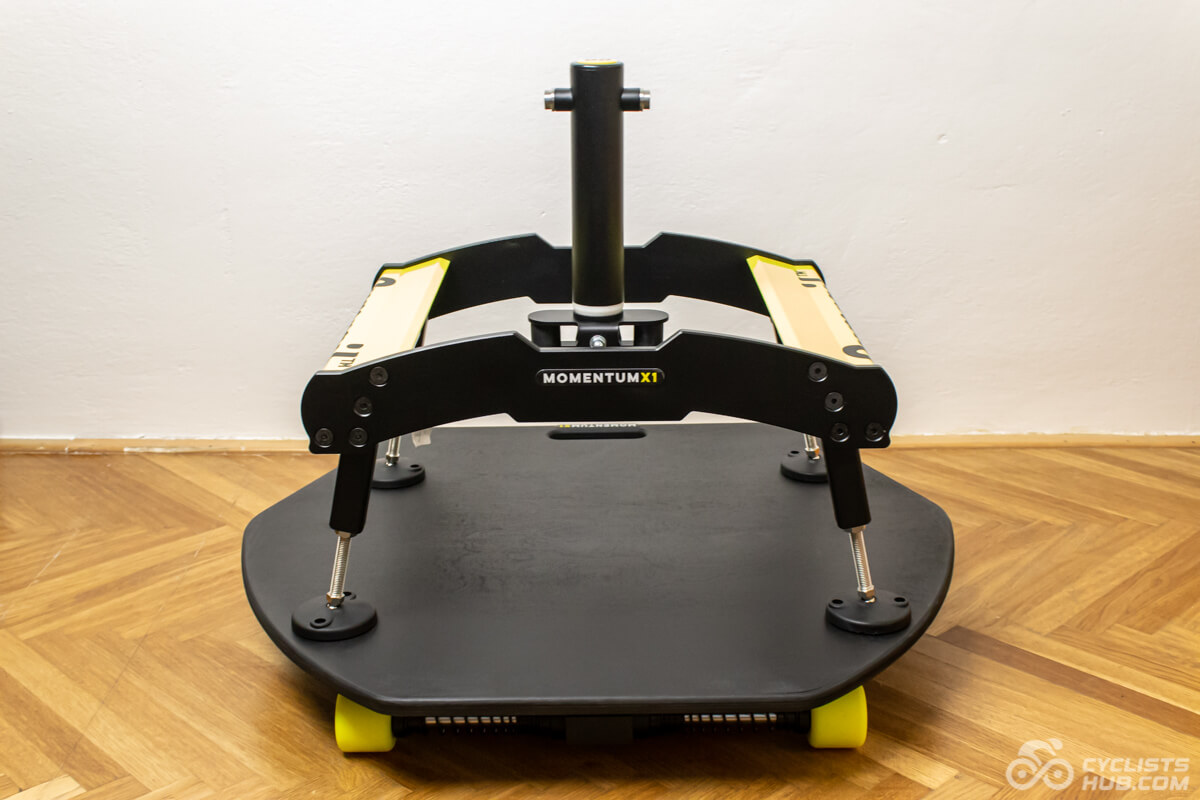
- 1 – E.g., the rocker plate is built from cheap materials and without attention to detail.
- 2
- 3
- 4
- 5 – E.g., the rocker plate is built from expensive materials and with attention to detail.
Price
I also included the recommended retail price (RRP) in the evaluation, although its perception is highly subjective. That’s why it has a relatively small weight in the overall rating. However, some rocker plates simply provide better value than others.
The evaluation is as follows:
- 1 – Above $1000.
- 2 – Between $750 and $999.
- 3 – Between $500 and $749.
- 4 – Between $250 and $499.
- 5 – Below $250.
Conclusion
I try to be as objective as possible when testing cycling rocker plates (and all other products). I aim to communicate my experience to potential buyers and help you make educated buying decisions.
Please remember that I am still tweaking and improving this procedure to provide you with the most valuable information possible.
Recent Updates
- Feb 12, 2024: V1.0 testing procedure introduced.