

Cyclists Hub is supported by its readers. We may receive a commission if you buy products using our links. All content on Cyclists Hub is written by humans, not robots. Learn More
I spent another $1100 on Garmin’s latest bike computers,1 so you don’t have to. I compared the Edge 550 with its predecessors and some competing bike computers. So, is it worth it?
KEY TAKEAWAY
I don’t think the Edge 550 is worth it, despite its excellent display and numerous advanced features. It’s simply too expensive given its lack of a touchscreen and such a short battery life. If you really want an Edge from the x50 line, consider the Edge 850 or even the Edge 1050. Continue reading for more information, or if you decide to buy the Edge 550 anyway, please consider using this link. These reviews take a lot of time and money, and I also buy these head units myself.
My Edge 550 rating at a glance:
Battery Life 2/5 | Ease of Setup 5/5 | Display 4/5 | Ease of Use 3/5 | GPS Accuracy 5/5 | Maps & Navigation 5/5 | Price 2/5 | OVERALL 3.7/5
More about this bike computer scoring.
NOTE: I tested the Edge 550 with firmware version 7.10.
Garmin Edge 550 Pros and Cons
These are the main pros and cons of the Garmin Edge 550 I found while using it.
Edge 550 Pros
- Excellent display brightness and sharpness
- Excellent display performance when controlling with gloves or when wet
- Customizable via a smartphone app
- Feature-rich (including Real-Time Stamina, Power Guide, Road Hazards, and more)
- Supports multi-band GNSS
- Easier battery replacement and repairs
- Garmin ecosystem
Edge 550 Cons
- The UI is improved, but still complicated
- Not so easy to use
- ClimbPro feature doesn’t offer enough customization flexibility
- Sub-par battery life compared to other bike computers
- Long startup time (~27s)
- No built-in speaker


Also available at rei.com, competitivecyclist.com, jensonusa.com, and tredz.co.uk
What’s New Compared to the Edge 540?
Below is an overview of what’s new on the Edge 550. For more info, check out my Edge 540 vs. Edge 550 comparison.
- Edge 550 has a larger, brighter, and higher-resolution 2.7” transmissive LCD; Edge 540 uses a smaller 2.6” transflective MIP display.
- Edge 550’s battery life is shorter in typical use (12 hours vs. 26 claimed for 540).
- Edge 550 is heavier (112g) but slimmer; Edge 540 is lighter (80g) but thicker.
- Edge 550 has double the internal storage (32 GB vs. 16 GB).
- Edge 550 uses a faster processor.
- Edge 550 features 5 Hz GPS recording for higher trail/enduro accuracy.
- Edge 550 introduces Smart Fueling (intelligent nutrition reminders) and an expanded Garmin Cycle Coach with weather and route adaptation.
- GroupRide, real-time weather on maps, and integration with SRAM AXS are available on both, but the Edge 550 integrates them more seamlessly.
- Edge 550 is designed to make it easier to repair and replace batteries.
- Edge 550 is significantly more expensive ($499 vs. $349).
In the Box
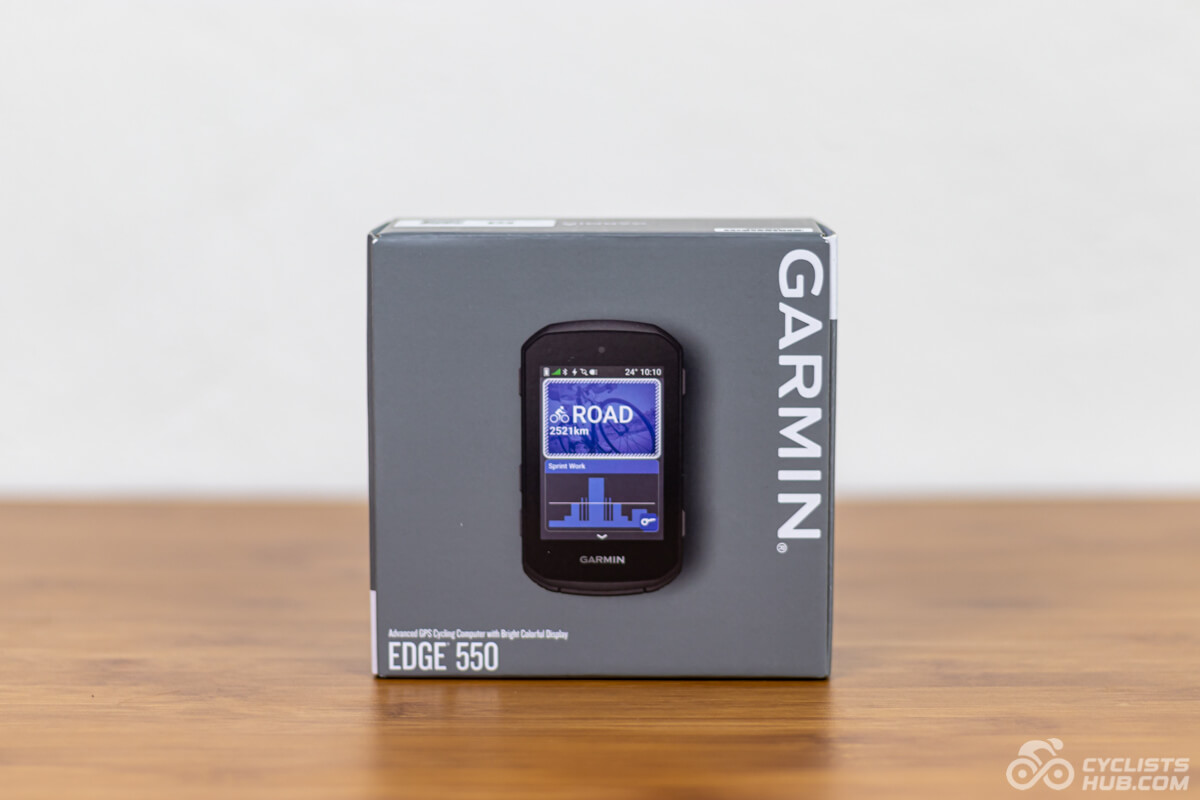
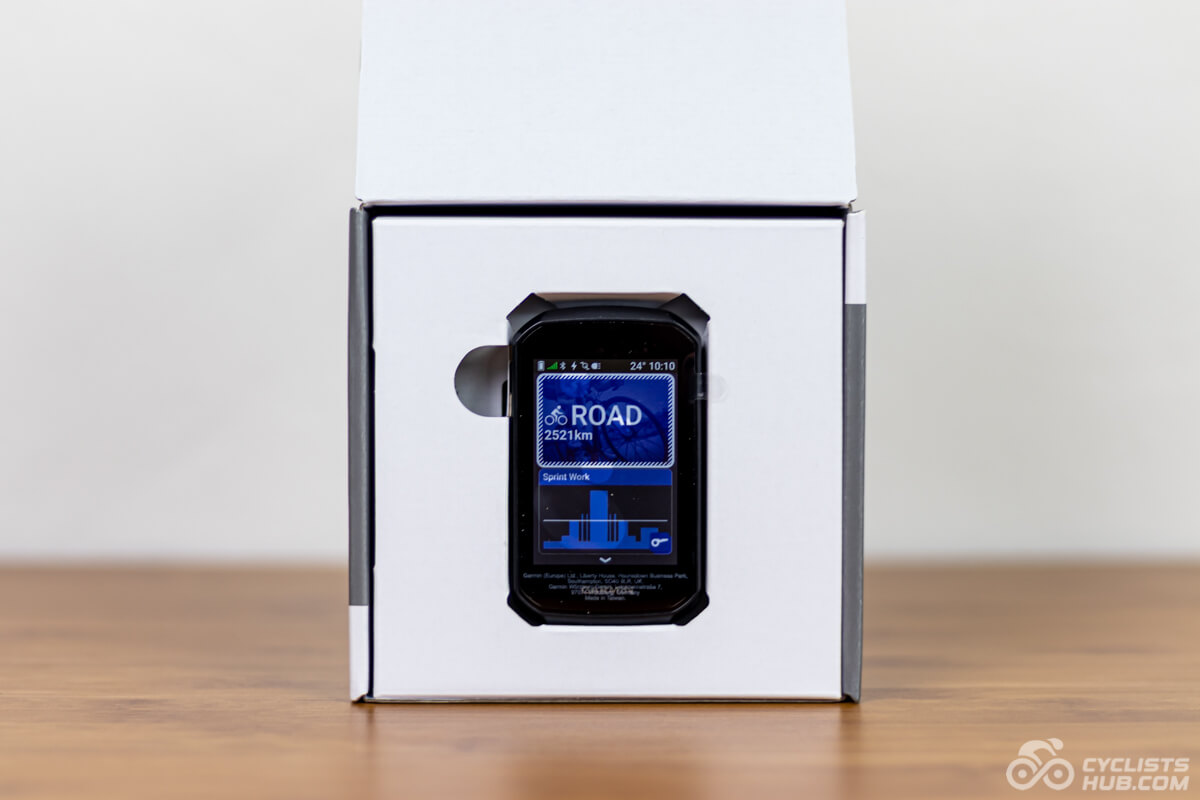
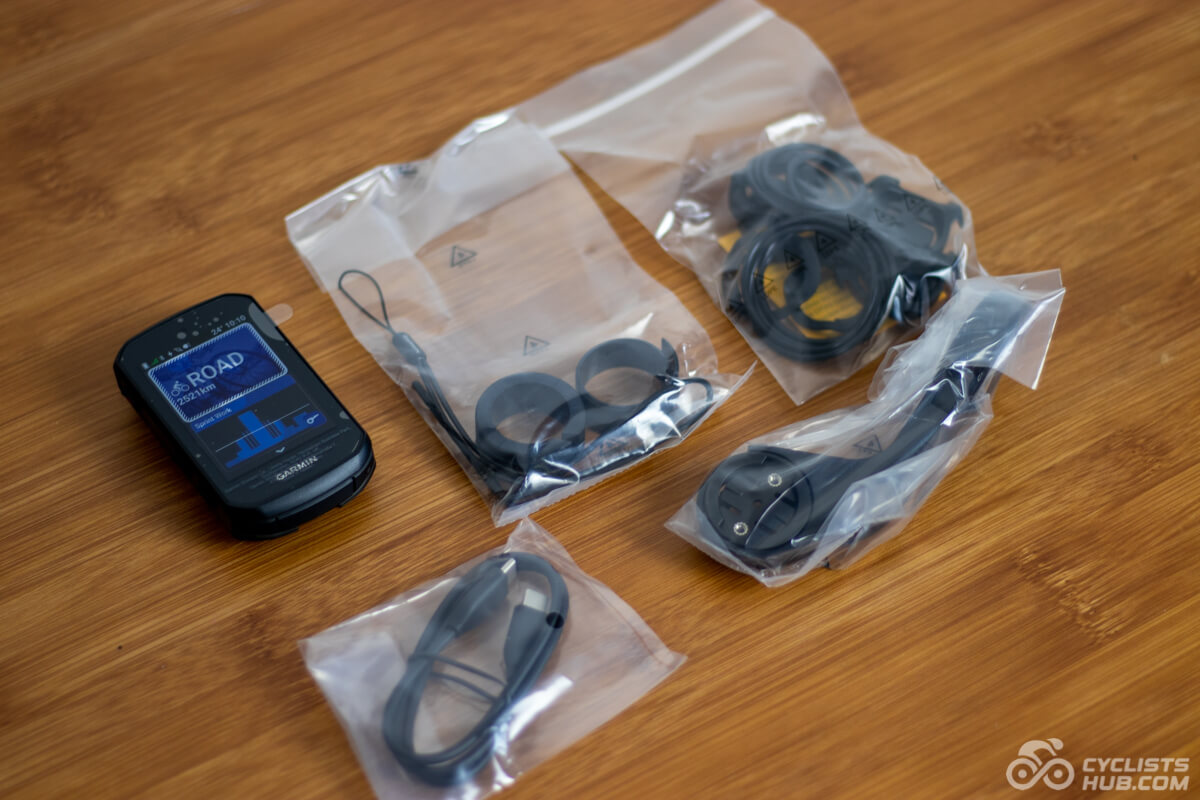
The Edge 550 box includes:
- Garmin Edge 550
- 1× Out-front and 1× stem mounts
- USB-C charging cable
- Tether
- Manual
Initial Setup
Setting up the Edge 550 is the same as previous Garmin bike computers. If you’ve used an Edge device before, your settings (including data fields) will be automatically downloaded from your Garmin Connect account. This is extremely convenient as you don’t have to spend time adjusting the data pages or pairing sensors. Wahoo ELEMNT bike computers can also sync data pages, but not sensors. So Garmin has an advantage here. The only settings I had to adjust were the widgets and their visibility.


The UI is identical to that found on the Edge 1050. Naturally, Garmin unified the entire lineup to provide a consistent experience.
My Experience with Garmin Edge 550
I’ve been using the Garmin Edge 550 for a few weeks now. Here are my main observations:
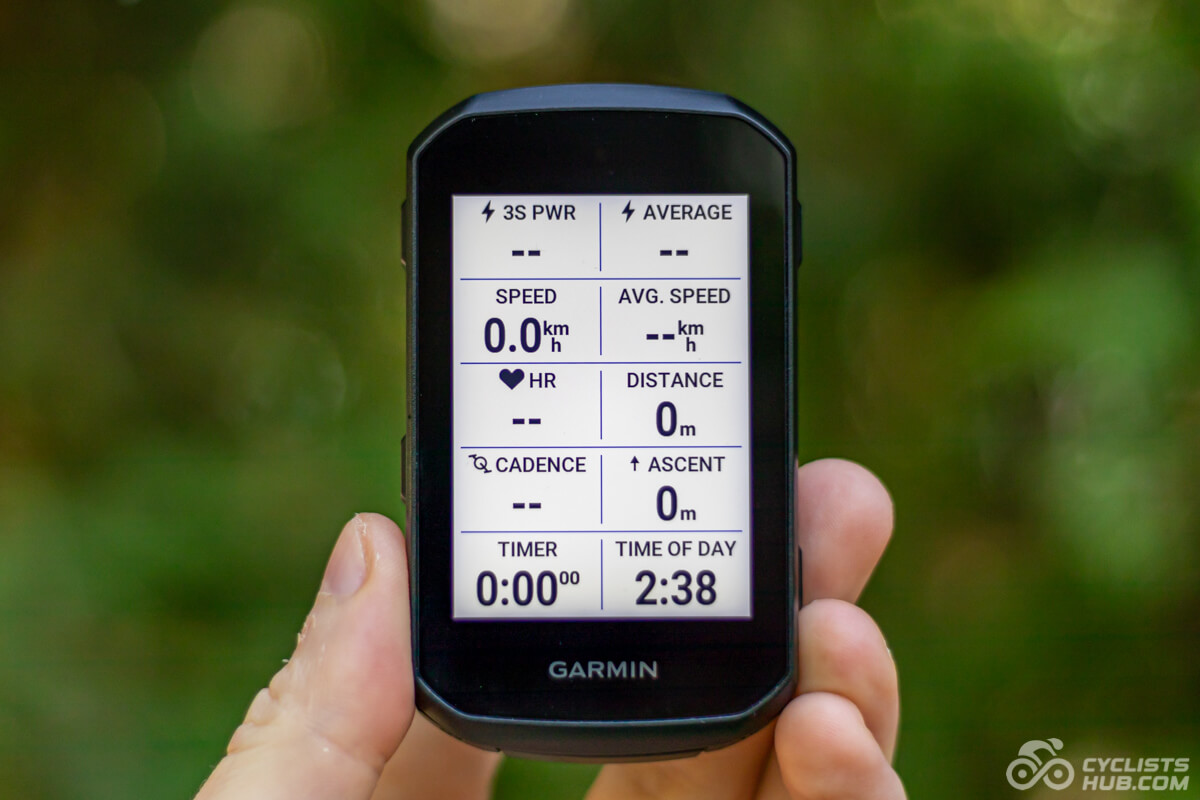
- The Edge 550’s display is easy to read in various scenarios.
- The battery life sucks.
Let’s now dive deeper into individual features.
Display
Garmin increased the display size by 0.1″, bringing it to 2.7 inches. Thanks to a technology known as transmissive LCD, it’s much brighter and easier to read in various scenarios (see the gallery below).
The pixels per inch (PPI) is lower than on the Wahoo ELEMNT BOLT 3 (271 vs. 376 PPI), for example, but everything looks sharp, so this is somewhat irrelevant.
The 0.1″ size difference is also negligible. The following chart shows the display sizes of other popular bike computers.
The display is now bright enough to be easily readable even in direct sunlight. However, it’s tricky to capture it on camera. The screen brightness varies depending on the tilt of the bike computer. Keep in mind that the screen surface is glossy, so it still reflects glare. The glossy screens detract from the Edge bike computers. An anti-glare coating could take them to another level. Below, I have included a gallery of various light scenarios and a comparison with different Edge bike computers.


Here is another comparison, this time with other bike computers. In practice, the Karoo 3 is the brightest, with the Magene C606 a close second. BOLT 3 and ROAM 3 are the least bright.

The Edge 550 can display up to 10 data fields at once, keeping them relatively easy to read, though they are naturally a bit smaller than on the 10×0 models.
Also available at rei.com, competitivecyclist.com, jensonusa.com, and tredz.co.uk
Battery Life
The Garmin Edge 550 has a dramatically lower battery life than the previous generation and most other bike computers on the market. It should last up to 12 hours, but the actual battery life is lower. It lasted only 10.3 hours for me.
I rode with a connected Wahoo TICKR, Elilee EK01, Garmin Varia RTL515, Shimano Ultegra Di2, and iPhone 14 Pro. I set the brightness to auto and rode in autumn temperatures (around 15°C [59°F]).
For comparison, the following chart shows the claimed battery life of the best bike computers on the market.
The poor battery life is one of the main reasons I would not recommend this bike computer. Yes, I know, it wasn’t that long ago that bike computers couldn’t make it over 10 hours, but those times are long gone!
Control & User Friendliness
The new user interface is an improvement over the previous one, but the Edge 550 remains button-based. This makes navigating the menus difficult. Although it is better than the previous interface, given the wealth of features of the Edge bike computers, it will always remain suboptimal for button-based control. I don’t understand why the 5×0 line wasn’t killed years ago. Wait, I actually do. I believe that the Edge 550 (and the previous 5×0 models) serves only one purpose: to make the Edge 850 and Edge 1050 look like a better deal. This “anchoring” strategy is pretty widely used.
Going through the data pages, widgets, maps, etc., is much easier on a touchscreen than with buttons, so if you care about that, Edge 850 is the way to go. The good news is that if you have an electronic groupset, you can pair it with your Garmin and switch pages via the buttons on your shifters.
Finally, the new chassis design simplifies repairs and battery swaps. This is mainly thanks to the EU’s Right to Repair legislation, which will take effect in 2026. You can remove the entire back panel, and the adaptor is replaceable as well.


Maps & Navigation
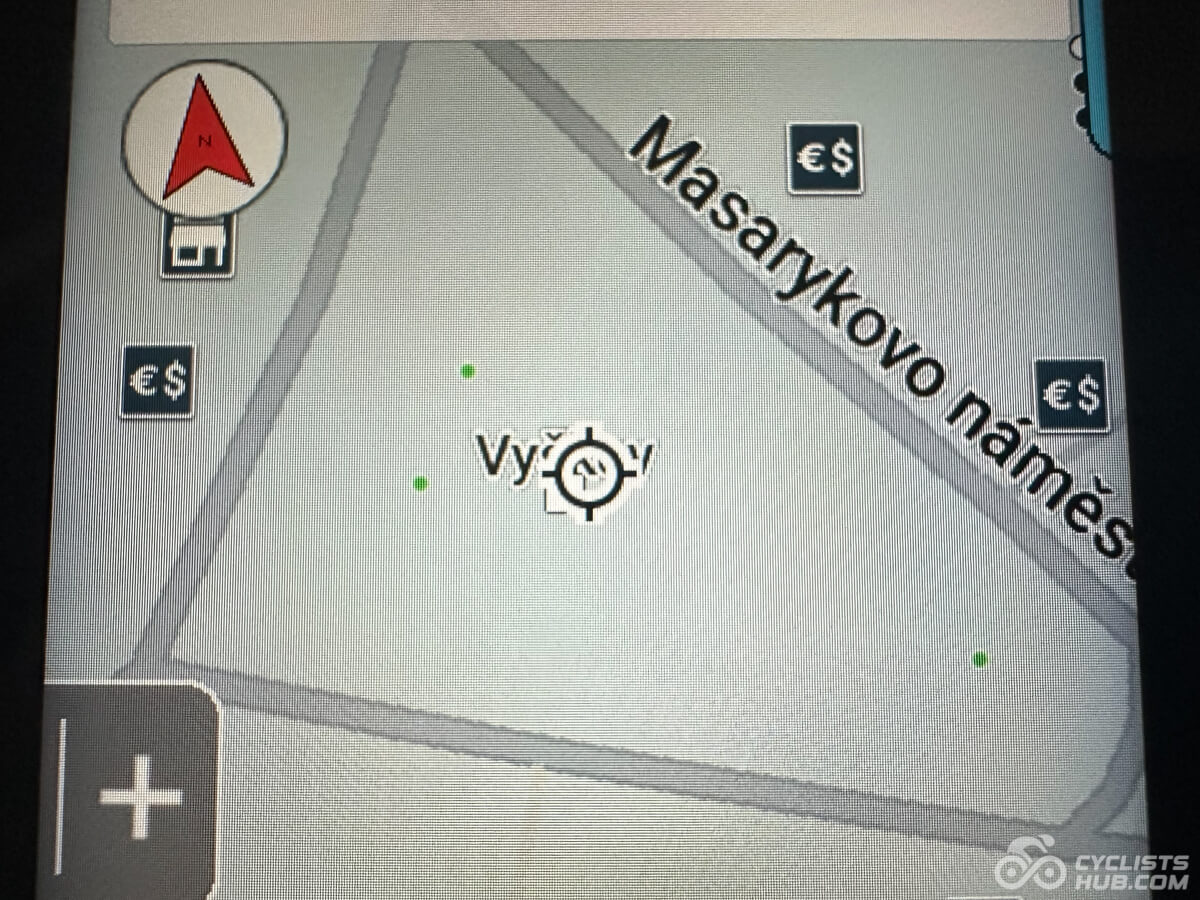
One of the improvements in the Garmin Edge 550 over its predecessor was in maps and navigation. They are easier to follow because the roads, trails, and other features have distinct lines and high contrast.


The Edge 550 can navigate you almost anywhere, but compared to the Edge 850 and Edge 1050, its navigation is somewhat more limited. The E550 doesn’t have address search, an on-device course creator, or audible alerts due to the missing speaker.
I tested navigation mainly on paved roads, and it worked flawlessly. Garmin has some of the best maps, even for off-road use. You can also install third-party apps, such as TrailForks, to explore trails. If you frequently use maps, consider the Edge 850 or Edge 1050 instead, as their touchscreens make browsing maps easier.
Also available at rei.com, competitivecyclist.com, jensonusa.com, and tredz.co.uk
GPS Accuracy
Because of its multi-band GNSS, the Edge 550 is one of the most accurate bike computers. When I test bike computers, I ride a specific segment in the forest, record my ride, and then compare the recorded route with the actual route and my previous tests.
I tested the Multi-GNSS Multi-band system because it’s the most accurate. The accuracy is so good that the ride recording precisely tracks my position on the narrow forest road. However, it drains more battery. Take a look at the following screenshots for reference.


ClimbPro
ClimbPro is one of the most useful features. You can slightly customize the data page and make the map smaller. So instead of 2 custom fields, there are now up to 4 (compared to the Edge x40 models). However, it’s a shame that there are no data fields, e.g., “Average power during this climb.” That would be very useful. However, you can work around this using the Avg. power (lap) field. You simply need to start a new lap before each climb.


Overall, I appreciate that Garmin inspired other manufacturers to implement similar features (mainly Wahoo and Hammerhead, but also a few Chinese competitors), as ClimbPro-like alternatives are among my favorite features.
Real-Time Stamina and Power Guide
With Real-Time Stamina, you can see how long you can ride at the current pace and how much energy you have remaining. Power Guide recommends power zones for your planned route based on your FTP. These features now account for additional metrics, such as route elevation, weather, and user profile. As a result, they are more accurate.
For example, when using Power Guide, it accounts for your Stamina and wind data. This means that if you encounter a headwind or your Stamina drops faster than expected, Power Guide will adjust the target power zones. This is a welcome improvement. It will be interesting to see what other metrics Garmin adds in the future to further improve accuracy.


Shared Road Hazards
Sharing road hazards, as Waze and Google Maps do, is a valuable feature. The more users contribute, the more useful it becomes. It may take time for enough Garmin users in some areas to contribute hazard reports. Garmin made this feature available earlier for the x40 models to expand the user base. This demonstrates another benefit of the Garmin ecosystem.

GroupRide, Challenges, and Awards
GroupRide has received several improvements. For example, if the E550 detects a crash, it notifies others in the group (when GroupRide is on). This is an excellent feature. I am surprised we didn’t get this feature sooner. This feature will be particularly useful during fast descents.
The Challenges are similar to Strava live segments. You can compete with your friends to see who can climb the upcoming hills faster. Currently, this feature only works for climbs in ClimbPro. This is Garmin’s way of giving you another reason to choose the Garmin bike computer and lock you into their ecosystem.
And the Awards are just Garmin’s way of leveraging additional gamification elements. Users earn rewards based on power output, speed, and other metrics.
These features demonstrate how Garmin encourages users to remain within its ecosystem.
Connectivity
Connectivity features remain unchanged. The Edge 550 still supports Bluetooth, Wi-Fi, and ANT+ connectivity, so you can connect it to sensors or your smartphone. It can also auto-sync activities and courses. Synchronizing activities has been reliable, but loading courses sometimes requires multiple attempts.
Garmin Edge 550 Alternatives
Here are some Garmin Edge 550 alternatives worth considering.
- Garmin Edge 1040 / 1040 Solar offers much longer battery life, but its features are not as advanced, and its display is a bit less bright. On the other hand, the display is larger.
- Garmin Edge 840 / 840 Solar is more affordable and has much longer battery life, but its features are not as advanced, and the display is not as bright.
- Garmin Edge 850 is almost the same but has a touchscreen and a few extra features like a built-in speaker. Of course, it is also more expensive.
- Hammerhead Karoo 3 offers a smartphone-like experience and an even brighter display. But it has fewer features.
- Wahoo ELEMENT BOLT 3 is easier to use and has a larger display and longer battery life, but fewer features and a worse display.
Garmin Edge 550 Technical Specifications
Below, I summarize the technical specifications of the Garmin Edge 550.
Technical specifications
- Battery life: 12 hours, USB-C charging port
- Display: 2.7in / 69mm (420×600px)
- Touchscreen: No
- Weight: 112g
- Dimensions: 92.2×54.6×16.8 mm
- Strava live segments: Yes
- Smart trainers control: Yes
- Smart navigation (rerouting): Yes
- Crash/incident detection: Yes
- Garmin Pay: Yes
- In-built speaker: No
- Connectivity: ANT+, Bluetooth, Wi-Fi, Multi-band GNSS
- Waterproofing: IPX7
- Storage: 32 GB
My Verdict
The Garmin Edge 550 offers many new, quite useful features, such as weather overlay, but it comes at a high price. Personally, I can live without them and believe that the previous generation offers better value for money. This is primarily because the Edge 550 lacks a touchscreen and lasts just over 10 hours in real use.
I hope you found this review helpful. If you decide to purchase the Edge 550, please use the links below. It’s the best way to support this website, and it won’t cost you anything extra. Thanks in advance.
Also available at rei.com, competitivecyclist.com, jensonusa.com, and tredz.co.uk
Recommended Accessories
Below are some recommended accessories for the Garmin Edge 550.
Garmin Varia RTL515 Radar

Garmin Varia RCT715 Radar with Camera

Garmin Edge 550 FAQ
- Garmin Edge 550 and Edge 850. ↩︎

I don’t know what Garmin is thinking with the cost and battery life on these new computers. Or that somehow they haven’t fixed screen glare. Meanwhile the new Wahoo computers have such dim screens. The Karoo climb app didn’t work for me on all but the steepest climbs so I sold it. Plus at that time it didn’t work with Shimano components and it syncs with very few apps. Guess I’ll stick with my Garmin 840 for quite a while yet.
Yea, the E840 seems like a way to go for the next couple of years. 🤷♂️
If battery sucks how can you give 4/5 points to the battery ?
Hi Mário,
Oh my god, I’ve forgot to update the scoring. Thanks for pointing that out! It’s fixed now.
– Petr