

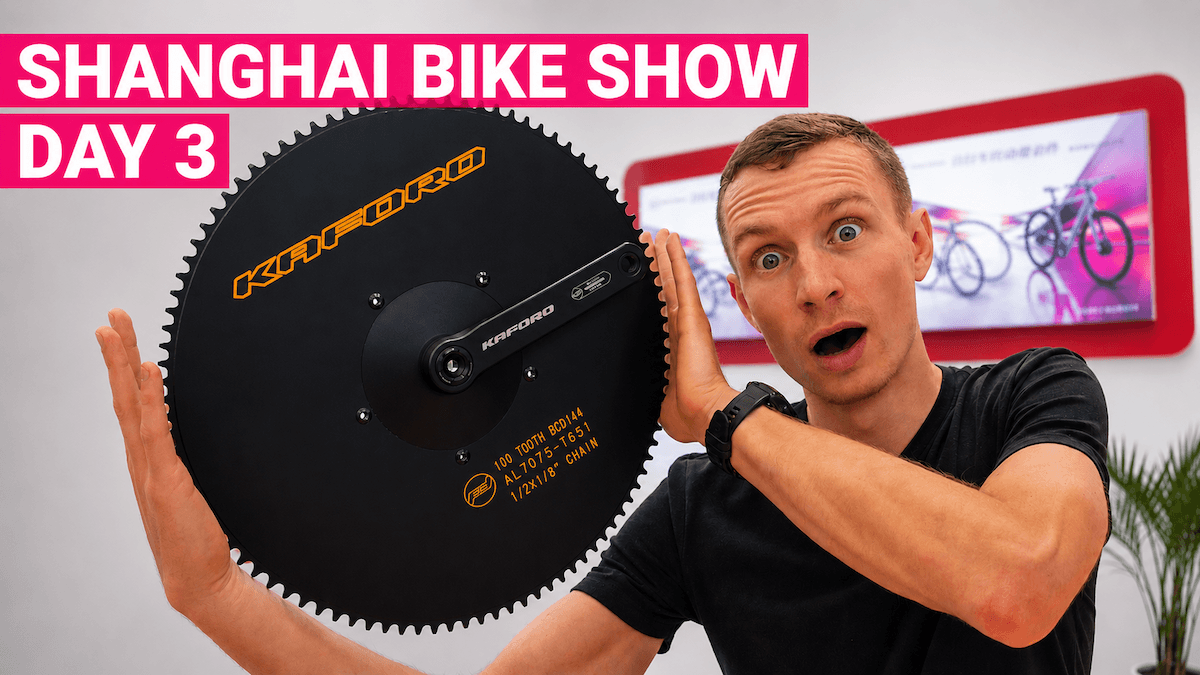
Alright, this one is the one not to miss. I found tons of super interesting, but also some of the stupidest cycling tech out there. It includes products from brands like Colnago, QuickPro, UPVINE, and many more.
Please watch, like, subscribe, and eventually consider donating. The entire trip is not sponsored by anyone, but it will cost me over $5000. You can use the Revolut or Wise links to send donations. Each dollar helps. 
You can also read below about how the day unfolded.
Colnago Y1RS: The Bike Pogačar Actually Rides
The Colnago Y1RS opened day 3 with an interesting comparison. The head tube design is very close to the INCOLOR SSR, and the raised handlebars and bayonet fork follow the same thinking. There was a rumor that the SSR and the Y1RS share the same designers, but it’s not entirely true. However, some ideas of the Y1RS come from the Incolor designer.
Later in the hall, the same Y1RS appeared on a second booth in a very different context: Tadej Pogačar’s actual race setup. ENVE wheels, the Hulk sticker, and a Bikone bottom bracket are worth examining closely. UAE Team Emirates had the notches removed from one side of the bottom bracket shell to reduce frontal area. A custom tool is inserted from that smooth side to tighten the bearing cup. The other side retains its notches for the standard tool. It is a detailed piece of marginal gains engineering from a team that takes aerodynamics seriously at every point on the bike. The chainring on this build is 56 teeth, paired with a 34-tooth cassette, though that changes with each stage and terrain.
For the record, the “fake” replica spotted at the Colnago booth used Fulcrum wheels, instead of Enve, and a 50-tooth chainring.
VOOK v9: One Piece “Forkpit”, No Adjustment
VOOK v9 showed an integrated handlebar-and-fork system built as a single unit. The claimed benefits are stiffness, since the force applied to the bar is transmitted directly to the fork without flex at any junction, and a slight weight reduction over a conventional two-part setup.
The downside is clear: there is no adjustment. No spacers, no stack options beyond two fixed heights they plan to offer. If the frame’s geometry does not suit a rider’s position, that rider is not the customer for this product. The computer mount bolt is still being designed. First ride impressions on something this stiff will be interesting when they come.
Time: Built in Slovakia
Time is one of the few brands at this show manufactured outside of China or Taiwan. Their frames are made in Slovakia, and the carbon layup is visible in person, distinguishing them from most of what surrounds them at the show. The craftsmanship argument for Time is real, and the frame was worth a stop for that reason alone.
Boostor: Limited Edition SSR and a Wheelset
Boostor had a limited-edition Incolor Speedster SSR on display, paired with a Boostor cockpit rather than their own. The stack is lower than on the standard SSR setup, but the bionet design is consistent across the range.
Their 60mm-deep wheelset had specific numbers attached: 26mm internal rim width, 35mm external, and a total weight of around 1250g. That is not light by current standards, but the rim width comfortably accommodates 34mm tires. Pricing sits around $1,200. When asked about hub manufacturing, the team said they have their own factory in Xiamen. The language barrier made it difficult to go deeper into more information.
10-52T 265g Cassette
I also came across a cassette spanning 10 to 52 teeth that weighs 265g. A comparable Shimano cassette comes in around 450g. The weight difference is significant. Unfortunately, I forgot the name of the brand.
ThinkRider: Smart Trainers and an Aggressively Priced Smart Bike
ThinkRider had their full smart trainer lineup on display, covering several models across different price and performance tiers. The new smart bike had not been officially launched or priced yet, but a special introductory rate of 4,000 RMB (roughly $600) was offered for the duration of the show. That is an aggressive entry price for the smart bike category.
Vortex: Wide Outside, Narrow Inside
Vortex wheels stand out through two specific design choices. The first is laser-etched dimples in the rim surface. When asked whether this is for aerodynamics or aesthetics, the team said it is primarily for design. That is an honest answer and refreshing compared to the usual approach of attributing everything to performance.
The second detail is the rim geometry. The internal width is 21mm, which is narrow by current standards. The external width is 36mm. That 15mm difference between internal and external is one of the widest gaps seen at the show, and the intent is to smooth the transition between tire and rim at the point where air passes over them.
The booth engineer also addressed a broader question about rim profiles. V-shaped rims are faster in terms of drag but significantly less stable in crosswinds. U-shaped rims give up some aerodynamic efficiency in return for better handling in real-world conditions. Having that conversation openly and technically, rather than claiming everything is fast in all conditions, was worth noting.
UPVINE: Engineering the Spoke Hole
UPVINE’s updated Pro+ wheelset changes two things from the previous version. First, the spoke material has been revised: the center section of each spoke uses a different compound, increasing overall stiffness. Second, the spoke holes are no longer drilled after molding; they are formed during the molding process itself, avoiding any structural compromise at those points.
Their ultra-lightweight line sits under 1kg and uses different rim profiles to achieve it. The engineer was straightforward about the trade-offs involved: a lightweight wheelset typically has a rim profile that is less aerodynamically optimal, less crosswind-stable, and potentially less stiff than a dedicated aero wheelset. No single wheel works equally well for every situation. That context is useful for anyone trying to make a sensible buying decision rather than chasing one headline number.
QuickPro: The Fullest Lineup on the Floor
QuickPro had the entire lineup on display. The ER:ONE is their flagship aero road bike and, based on wind tunnel testing, sits in direct comparison with the Cervelo S5, which it was reported to match or beat. The AR:ONE and TR:ONE round out the road and triathlon options, and the TR:ONE in particular is worth noting as the category of quality Chinese triathlon bikes continues to grow.
The TT:ONE follows UCI regulations closely. Placing it next to the non-UCI TR:ONE shows clearly where the rulebook forces compromises in tube shaping and geometry.
The UR:ONE is their newest and most expensive frame. It uses T1200 carbon, which is being used in one of their frames for the first time. Whether the material grade is meaningfully perceptible in ride quality versus T1000 or M46 is a fair question, and one that deserves skepticism without real testing.
Their Canin wheel sub-brand is being retired and replaced by a new brand called Rory. The gravel frame, finished in raw carbon, has the kind of surface detail that is hard to photograph and only reads well in person.
Laget: A 3D-Printed Titanium Frame at $10,000
Laget showed a 3D-printed titanium frame that was difficult to walk past. The top tube is less than half a centimeter thick. The down tube narrows significantly at the point where the fork joins, attempting to mirror an aero teardrop profile. The seat tube is the thinnest on any frame seen at the show. The seat stays are heavily shaped throughout.
The frame weighs approximately 2.2kg, which is not light. The price is approximately $10,000. Neither of those figures makes it a practical option for most riders, but as an example of what additive manufacturing allows in terms of geometry, it earns its place on a show floor.
Troxus: Italian Design Language, Silverstone Data Withheld
Troxus is showing a bike they describe as designed by Italians. The bayonet handlebars and fork appear here as they do across several other brands at the show. The rear end has shaped seat stays that echo the Trek Madone, with the seat post running inside the frame to allow height adjustment. Silverstone wind tunnel testing has been done, according to display material at the booth, but the actual data was not provided. Without numbers, the claim is informational rather than substantive.
Bross: The Zenit Plume
Bross had a range on display anchored by the Zenit Plume, their top-end aero frame. The deep fork design is reminiscent of the Winspace M6. Based on what others who have ridden Bross say, the brand delivers more than its appearance suggests. I don’t have first-hand experience, but this frame is on the list.
The lower-end frame looks like carbon at a distance but is aluminum. The giveaway is the bottom bracket area where the welding becomes visible on close inspection. The Zenit, in a color-shifting paint that changes shade depending on the viewing angle, was one of the more attractive finishes at the booth.
ONIRII: Lefty and Lightweight Wheels
ONIRII had a bike running a Cannondale Lefty fork, and the paint job was worth a look before moving on. Beside them, Vcycle was showing their Light wheelset at approximately 980g for a 50mm depth. Sub-1kg wheels at 50mm are becoming less unusual by the day at this show. The rim has a wave-like profile, impressive.
Magene: The C706 Bike Computer
The Magene C706 caught attention not for any single headline feature but for a combination of things done well. Ambient lighting around the unit is an aesthetic addition that serves no functional purpose but makes the device look considered rather than utilitarian. The bezels are narrow. The display reads clearly from off-axis angles. There is a speaker built into the unit, delivered from the body rather than a grille, which raises questions about volume, but audible navigation alerts are increasingly useful when riding in traffic.
Elilee: Concepts Triathlon Bike and Carbon Cranks Lineup
Elilee showed a triathlon concept bike that combined components from several different groupsets in a way that would raise questions from any mechanic. SRAM RED derailleurs, Dura-Ace chainrings, and an EK01 power meter with Elilee cranks all appeared together on the same drivetrain. It is clearly a concept rather than a recommendation.
More practically interesting were the carbon cranks. The X310 cranks are lighter than Dura-Ace, which Elilee confirmed with testing. The X-Trecento crank is lighter still and uses a carbon fiber axle rather than titanium to further reduce weight.
Batch Bike with Hidden Details
I found the Batch bike with an integrated speedometer in the handlebars that removes the need for a separate computer for riders who only need speed data. A protective sleeve wraps the top tube as both a style element and a surface treatment. An integrated light is built into the seat post. And the thumb shifters use an inside-placement design drawn from the L-Twoo groupset. None of those details individually define the bike, but together they suggest a brand thinking carefully about integration rather than assembling parts.
Day 3 done. Make sure to check out my day 1, day 2, and day 4 coverage.
