

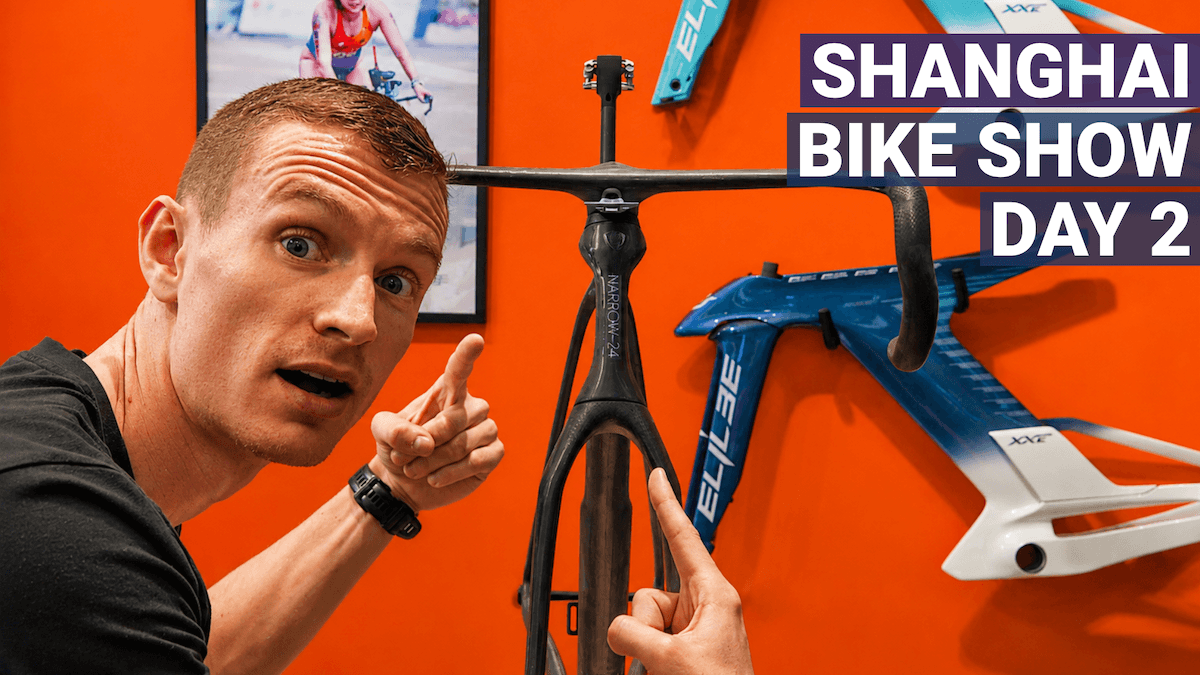
It wouldn’t be proper coverage without experiencing a lack of sleep. After day 1, when we encountered technical difficulties, my cameraman and I dug deep, and we produced another video. I will guide you through new products from Elilee, Winspace, Tavelo, and many more!
Please watch, like, subscribe, and eventually consider donating. The entire trip is not sponsored by anyone, but will cost me over $5000. You can use the Revolut or Wise links to send donations. Each dollar helps. 
You can also read below about how the day unfolded.
Elilee: The Frame That Could Undercut Everyone
The new Elilee Suanni frame follows the narrow head tube direction that dominated day 1 as well, and when placed next to the INCOLOR SSR from yesterday, the frontal area reduction is comparable. That trend is not going away.
The numbers are worth stating clearly. The frame itself, including the integrated seat post, weighs 700g. The fork is 350g. The bottom bracket standard is BSA, which is a practical downside compared to T47, but it is what it is. More relevant for most buyers is the seat post situation.
Integrated seat posts reduce resale value because the next owner needs to share your riding position. Elilee has built in a two-type system to address this. The first seat post type has no height adjustment. The second can be inserted if the first is cut too short, recovering some height. It is not a perfect solution, but it is a smarter one than most brands offer, and it removes some of the anxiety around cutting correctly.
The price should sit around $2,000 when it goes on sale at the end of July or the beginning of August. The INCOLOR SSR costs over $4,000. For a frame that offers a comparable spec on paper at roughly half the price, that gap will attract attention. Wind tunnel testing at Silverstone has not been completed yet, but it is planned. A white paper with CFD models is already available, and I might publish it later.
One more thing at this booth that got missed on day 1: the EK01 power meter. The new generation weighs 59g for the complete unit, including the spider. Getting the firmware dialed in matters more than the weight for a power meter, but the number is still notable. Elilee also sponsors the Bahrain Victorious pro cycling team, which uses both their power meters and carbon cranks.
S-Parts: Titanium Hardware for Customization
S-Parts manufactures titanium bolts and small hardware components as replacements for the steel parts that come standard with most frames and components. The use case is weight reduction and aesthetics: swapping out stock steel bolts for colored titanium ones changes the look of a build and removes a few grams at the same time. The seat post finish on display was worth a look, with a surface texture that stood out from standard options.
Santic: Practical Shoes Without the Price Tag
Santic shoes are among the more popular cycling shoes on AliExpress, and the booth reflected that positioning. Instead of Boa dials, which carry a licensing cost, they use a similar rotating closure system. The fit and finish looked solid rather than cheap. For anyone shopping primarily on value rather than brand name, these are worth considering.
CRW: Wheels and a Cockpit Worth Noting
CRW had their full wheel lineup on display with the hubs accessible so visitors could handle them directly and check the ratchet engagement. The cockpit on show was the more interesting detail. It has an elevated profile similar in concept to the Cervelo cockpit, and it fits the broader trend that was visible across the show: frame designers are increasingly building bikes with stacks high enough to accommodate riders who want aerodynamic positions they can actually hold for more than an hour. The handlebars are the first thing that enters the wind on any bike, and their shape matters more than the frame shape in many scenarios.
The Wrapped Rear Wheel Concept Bike
There was one road bike at the show that deserved attention. It combined TT-style aero bar extensions integrated into a standard road handlebar setup with a frame design that fully wraps the rear wheel in carbon. The goal is obvious: eliminate the wheel as an aerodynamic variable by routing air around it entirely. The brake calipers are semi-hidden within the frame structure for the same reason. No aerodynamic data was on display, so whether the execution matches the ambition is unknown. But as a direction of thinking, it is interesting.
Sava: A TT Bike With a Questionable Down Tube
Sava had a TT bike on display running the L-Twoo groupset. The detail that caught attention was the down tube profile. On an aerodynamic bike, the leading edge of any tube should be smooth and gradually transition to a sharper trailing edge. The Sava downtube appears to do the opposite: the front edge is sharper, and the rear is blunter. Compared to other bikes in the same hall, the drag reduction from the down tube shaping is probably limited. That is worth knowing if aerodynamic performance is the reason for buying a TT bike.
VONOA: How Sub-1kg Wheels Actually Get Built
The VONOA booth was a useful stop for understanding what is actually happening inside the wheels that brands like Overfast and Particle are producing. VONOA makes carbon spokes used across a wide range of Chinese wheelsets.
Two things from the conversation there were worth noting. First, their bonding process is mechanical rather than adhesive-based. The spoke end is shaped differently from a standard spoke, and the nipple locks onto it mechanically rather than relying on glue for tensile strength. Second, their ultra-light spokes weigh 1.7g each. That figure is a significant part of how complete wheelsets get below 1kg while maintaining structural integrity. They also offer two nipple options: steel and titanium. The titanium nipples offer better corrosion resistance for riders in wet or salty conditions.
Cycplus: A New Power Meter, But Wait for Reviews
Cycplus announced a new power meter at the booth. The claimed accuracy is plus or minus 1%, and the battery should last around 200 hours. The form factor looks similar to a few other power meters seen at the show today, which raises the obvious question of shared manufacturing origins.
The more practical advice here is to wait. Cycplus announced its L7 radar in 2023, and it did not reach customers until the end of 2024. Accuracy claims on power meters need independent verification (also via tools like my FIT File Analyzer) before they mean anything. Waiting for reviews from people who test these systematically is the right call.
Winspace: T1600 Ultra and the M6
Winspace had two bikes worth discussing. The T1600 Ultra is an updated version of the T1600 frame. The changes are specific: a raised handlebar replaces the flat one, and the fork has been redesigned to a more even profile compared to the previous curved shape. The weight remained the same after checking with the Winspace team. So the two updates are the handlebars and fork, nothing else.
The raised handlebars are the meaningful change. The T1600 has a low stack, and the raised bar directly addresses riders’ struggles to maintain an aggressive position during extended efforts.
The M6, which is arriving for review shortly, was shown with TT handlebars and extensions fitted. Winspace does not make a dedicated TT bike, and pairing the M6 this way appears to be how they are equipping their women’s cycling team for time trial stages.
Also at the Winspace booth was a budget build under the Legit name, which is Winspace’s more accessible option. It runs a Chinese mechanical 1X groupset, with a 50-tooth chainring and an 11-45 cassette. The gearing covers flat roads and rolling terrain without needing a front derailleur.
Avenger: Three Very Different Bikes
Avenger had a range on display covering different use cases.
The R8 RS is their current aero road bike. It is designed specifically to accept TT extensions, which is a practical feature for triathletes or riders who want versatility without buying a second frameset. The head tube leading edge is sharper than on many comparable bikes, and it has some visual similarities to Winspace’s approach, though whether that reflects shared thinking or coincidence is hard to say. Wind tunnel data was available in their booklet.
They also had a frame with hidden internal compartments and a water storage section built into the frame structure. Frames built for non-UCI events have more design freedom, and this is an example of what that looks like when taken seriously.
The Avenger Shuttle is the lightweight option in their range. The build on display used Elilee X260 cranks with carbon chain rings, Dura-Ace with a direct hanger, and a non-Shimano cassette. The weight felt to be around 6.5kg.
Panda Podium: The Evolve Cima GR and a 5.5kg Build
The Panda Podium booth had two bikes that stood out.
The Evolve Cima GR is the gravel version of the Cima road frame. Aero bar extensions are already integrated into the build, which makes sense for ultra-long gravel races where a sustained aero position saves meaningful energy over many hours. It runs the L2 groupset. Reliability and shifting quality on that groupset are still areas where real-world data matters more than claims.
The second bike at this booth was more striking, the Incolor Speedster SSR. Narrow head tube, similar in principle to what has been seen across the show, but the complete build weight is 5.5kg. That figure requires a specific component selection, and it shows: Overfast wheels and through-axles, a particularly light saddle that clearly prioritizes weight over long-ride comfort, and a two-by drivetrain. There are no savings from a single chainring setup here.
They also had the Mentech build that looked heavier than it is. The actual weight was 7.2kg on Shimano 105, which was lower than expected on first glance.
The design follows current thinking: raised cockpit with a handlebar that increases the stack for a more sustainable aero position, and 38mm tire clearance with tires that stretch to 40mm under pressure. The combination of wider tires and higher stack points toward longer-distance riding rather than pure racing. The groupset is L-Twoo, paired with Cybrei cranks and chainrings.
The standout detail is the paint. A blue finish with enough depth and texture to hold attention in a hall full of bikes, trying to do the same thing.
Yoeleo: A Logo Update and Some Progress
Yoeleo has redesigned its logo. The previous version attracted criticism. The new one is cleaner and less distracting, but still not to my taste. The paint options have also improved. It reflects a brand paying closer attention to how it is perceived, which is a reasonable step.
Tavelo: The Arow Refresh and the Grow
The Tavelo booth had the refreshed Arow frame in multiple colorways. The geometry has been updated, not just the aesthetics. The head tube is slimmer than before, the down tube is also slimmer, and the bottom bracket area has been widened for stiffness. The result is a frame that should be more aerodynamic than the previous version. The stack has increased by 2cm compared to a flat handlebar setup, and raised handlebars are available as an option for riders who need more.
The Grow gravel frame, which Tavelo recently launched, allows chainrings up to 50 teeth while accommodating wide tires. The intent is to let a rider run a large gravel tire for off-road sections and swap to road wheels for speed on tarmac without needing to change anything else on the bike. The raised handlebar fitted to the display build was the same setup seen elsewhere at the show today: more stack, more time in an aero position before fatigue forces a change.
That was day 2. Make sure to also check out day 3 and day 4 here.
