

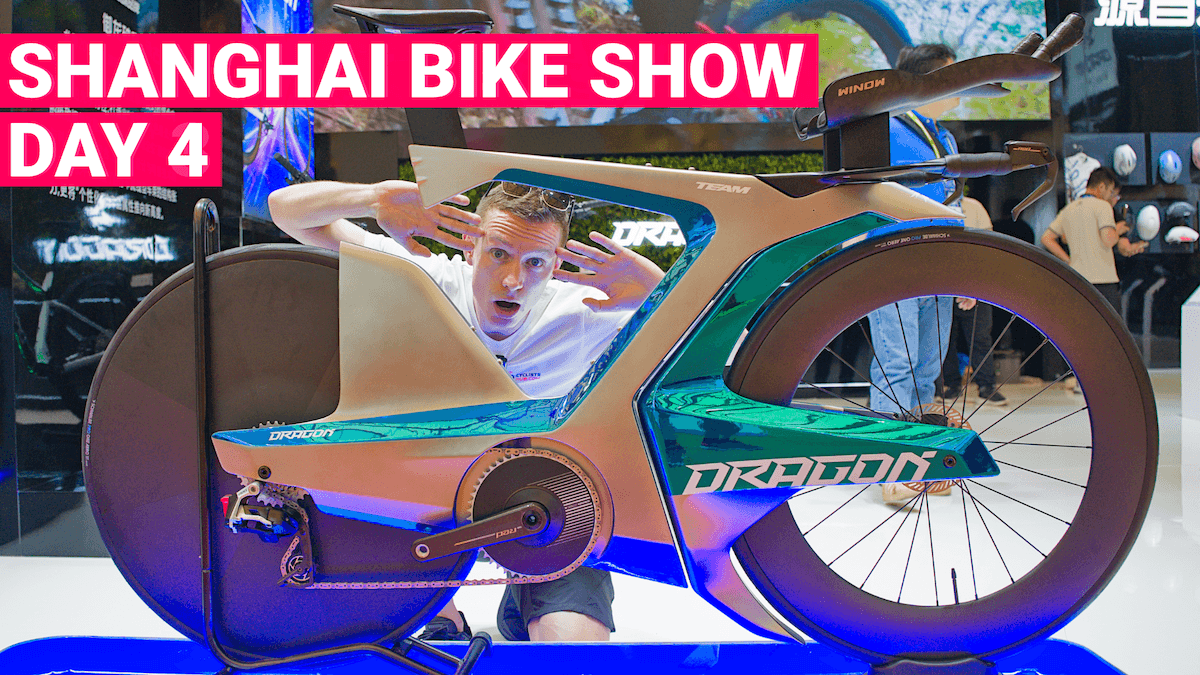
There were still many brands to explore during the 4th day. I visited SEKA, Wheeltop, Welgo, Voice, and many more.
Please watch, like, subscribe, and eventually consider donating. The entire trip is not sponsored by anyone, but will cost me over $5000. You can use the Revolut or Wise links to send donations. Each dollar helps. 
You can also read below about how the day unfolded.
SEKA: Aerobottles Still Pending, Cairo TT Taking Shape
SEKA had their gravel bike on display, and for anyone following this brand since Eurobike last year, the aerobottles are still not finalized. The team wants to make a few more adjustments before they consider them ready. The blue paint on the gravel bike is genuinely impressive in person and worth seeing if you get the chance.
The more notable product at the SEKA booth was the KAYROI TT. The designer explained the geometry thinking behind it: the goal was a high stack without a tall head tube. That gap between the top of the head tube and the handlebar position is intentional, and it leads directly to one of the KAYROI more unusual features: golf ball-style dimples on the down tube. The reasoning is that as air travels around the front wheel and hits the down tube, the dimples help manage that airflow rather than letting it create drag. The same dimple texture appears on the seat post. The frame also uses the Wind-Eye cutout structure that appears on SEKA’s Spear model, keeping the design language consistent across the range.
The cockpit on display is not final. The Cairo TT is being developed in collaboration with Vittoria, and the production configuration, pricing, and final components are still being decided. What is already clear is that SEKA is building toward a lineup capable of supporting professional team sponsorships.
No.6: A Full Wheelset Refresh
The No.6 booth had a significant amount of new information. Their entire wheelset lineup has been refreshed, with changes across rim width, rim depth, weight, hub design, spoke numbers, and improved aerodynamics. The hub changes are described as minor compared to the other updates, so the rim dimensions and weights are where the meaningful differences sit.
Regarding aerodynamics, they stated that the new wheels are a few watts faster than the previous generation in Silverstone wind-tunnel testing. That data has not been publicly released yet, so it is worth waiting for the numbers before drawing conclusions.
Two other details are worth noting. The ratchet uses 45 teeth. A higher tooth count gives faster engagement, but it also increases the chance of slippage under hard load, so a higher number of teeth can be a trade-off rather than a straightforward upgrade. More practically useful is their four-year bearing warranty. Many brands offer no bearing warranty at all. Having a warranty that covers replacement at no cost is a meaningful differentiator.
Voice: A Road Frame and a Prototype That Asks Questions
The Voice Echo road frame has a noticeably thin top tube and a seat post with a deliberate gap cut into it, intended to add vertical compliance and reduce road vibration. The frame is UCI-approved. The down tube is thin at the top, where aerodynamics matter, and widens considerably toward the bottom bracket, where stiffness is the priority.
More unusual was the full-suspension gravel bike they had on display. Front suspension travel runs from 50 to 80mm, rear travel is up to 70mm. The wheels use Goosynn spokes, which are made from fabric rather than carbon or steel. Fabric spokes are more compliant than either alternative, which suits a bike designed for comfort over rough terrain. The trade-off is lower stiffness, which limits their suitability for high-output racing applications.
The frame on display is 3D printed from plastic because the carbon production molds were not ready in time for the show. The production version will be carbon. Whether this design finds a market in gravel racing or eventually crosses into cross-country use is an open question, but the engineering intent is clear enough.
Prowheel: Cranks, Power Meters, and a Detail Worth Knowing
Prowheel makes cranks and has now added power meters to its range. They have two variants. The first was developed in collaboration with Xcadey, which has more established experience in power meter manufacturing. The second is their own in-house design, integrated more cleanly into the crank body.
They make both aluminum and carbon cranks, and they were straightforward about the fact that entering carbon manufacturing required a separate investment and capability set compared to their existing aluminum work.
One thing worth clarifying for anyone shopping for cranks: a crank that appears to be fully carbon is not always fully carbon. In several examples at this booth, and across the show more broadly, the crank arms are carbon, but the chain rings are aluminum with a carbon-weave wrap applied on top. Cybrei does the same. It looks identical to full carbon in photos and in person until you look closely. The functional difference matters depending on what you are paying for.
Nexga
The Nexga booth made the chain ring material question much easier to understand. They had examples showing the difference side by side: one chain ring with carbon fiber construction for the body and aluminum for the teeth, and another that is fully carbon throughout, including the teeth. The distinction is exactly what was discussed at Prowheel, but here you could see both versions side by side.
Wheeltop: Promising Concepts, Shifting that Needs Work
Wheeltop acquired Rotor and used this show to display a broad range of products: electronic dropper posts for gravel, oversized pulley wheels, a fully automatic MTB groupset, a new TT groupset, and road groupset options.
The automatic MTB groupset shifts based on riding conditions. Pedaling harder triggers a downshift to a harder gear; hitting a steep climb triggers an upshift. The idea is sound.
The road groupset and TT groupset are less ready. During hands-on testing at the booth, the tactile feedback from the shift buttons was poor, the force required to trigger a shift was higher than expected, and at several points pressing the button produced no shift at all. Shifting under load was rough. These are solvable problems, but the current state suggests the product needs more development time before it is ready for real use.
Zuatu: €1,200 Carbon Shoes for Indoor Use Only
Zuatu showed custom carbon cycling shoes at €1,200, heat-mouldable to the rider’s foot shape and made almost entirely from carbon. It has the closure dial positioned at the sole, making them unsuitable for outdoor use.
The version with the rear-dial would be more interesting of the two from an outdoor perspective, since a smoother shoe exterior marginally improves aerodynamics, but shoe covers remain an option in most road situations. Whether either model justifies its price for the majority of riders is another question.
Welgo: Pedals With a Few Genuinely New Ideas
Welgo makes pedals, and they are known on AliExpress. Their road pedal with integrated power meter is a form factor that does not appear often. Accuracy is claimed to be plus or minus 1%; one pedal weighs 150g, and battery life was not confirmed at the booth. Their MTB platform pedals also include a power meter option. However, GP Lama told me these were already teased a while ago and never released.
The most interesting product at this booth was a pedal that allows the rider to adjust Q-factor, the lateral distance between the pedal platform and the crank arm, by up to approximately 5mm. The pedal body moves along the axle to achieve this. For riders who are still determining what Q-factor works for their physiology, being able to test different positions on the same pedal rather than buying multiple setups is a practical feature. The pedals are on the heavier side, but for fitting purposes, that is probably acceptable.
A Conversation on the Floor with Luke from TraceVelo
With the booths starting to be dismantled around midday, there was time to chat with Luke from the TraceVelo channel, who was also covering the show.
RideNow’s carbon ceramic disc rotors came up as one of the highlights. Luke had previously tested a set of carbon ceramic rotors from Carbonova, where a proprietary brake pad compound was central to the product. The RideNow version uses standard sintered metal pads, which makes a direct comparison worth pursuing once both have been tested under similar conditions.
The Elitewheels wheelset with spokes integrated directly into the rim structure, covered earlier in the show, generated discussion about the manufacturing process. Placing two molded halves together to form a complete rim with integrated spoke attachment points raises real questions about mould extraction, layup consistency, and defect rates. The stiffness argument in favor of integration is clear. Whether the production complexity and likely high price make it worthwhile for a buyer is less clear.
Luke flagged Ningbo Suyu Transmission, a groupset manufacturer showing a 2×12-speed electronic groupset aimed at under $300. It has been refined since last year’s showing and is now closer to the finish level of the first-generation L-Twoo ERX. The battery for the entire system lives in the front derailleur, which makes the front derailleur physically large. The shift buttons are still not quite there in terms of feel, but the system functions. At that price point, if reliability improves, it could open up electronic shifting to a segment of the market that currently has limited options.
Java’s folding carbon bikes also came up. Lightweight folding bikes have been almost entirely Brompton’s territory, and Java is entering with a carbon approach. Luke found them worth noting.
On the broader question of the show itself: one piece of information passed along from exhibitors was that booth costs at China Cycle are approximately ten times lower than equivalent space at Eurobike. That price difference, combined with the scale of the audience and the domestic manufacturing infrastructure, goes a long way toward explaining why the booths here are so much larger and the product volume so much higher than at European shows. The show grows year on year. Eurobike, by contrast, has seen several major brands reduce or remove their presence entirely.
That was the Shanghai Bike Show 2026. Four days (make sure to also check out day 1, day 2, and day 3), an enormous amount of new products, and a clear picture of where cycling technology is being developed fastest.
By the way, here is a bonus. This video features products that didn’t make it into one of the first three videos.
