

Cyclists Hub is supported by its readers. We may receive a commission if you buy products using our links. All content on Cyclists Hub is written by humans, not robots. Learn More
I met Philip, the engineer behind Incolor’s frames, at the China Cycle 2026 expo. I asked him tons of (sometimes pretty silly) questions. He patiently walked me through Incolor’s bike range, and at the end, I could even try the TTR and SSR. Here’s a short rundown of what the video covers.
- SR & SR Plus: Sharing the same road frame geometry, the SR Plus upgrades to a higher-grade carbon and 3D-printed titanium details, saving 60 grams over the T800-based SR while maintaining identical stiffness and comfort.
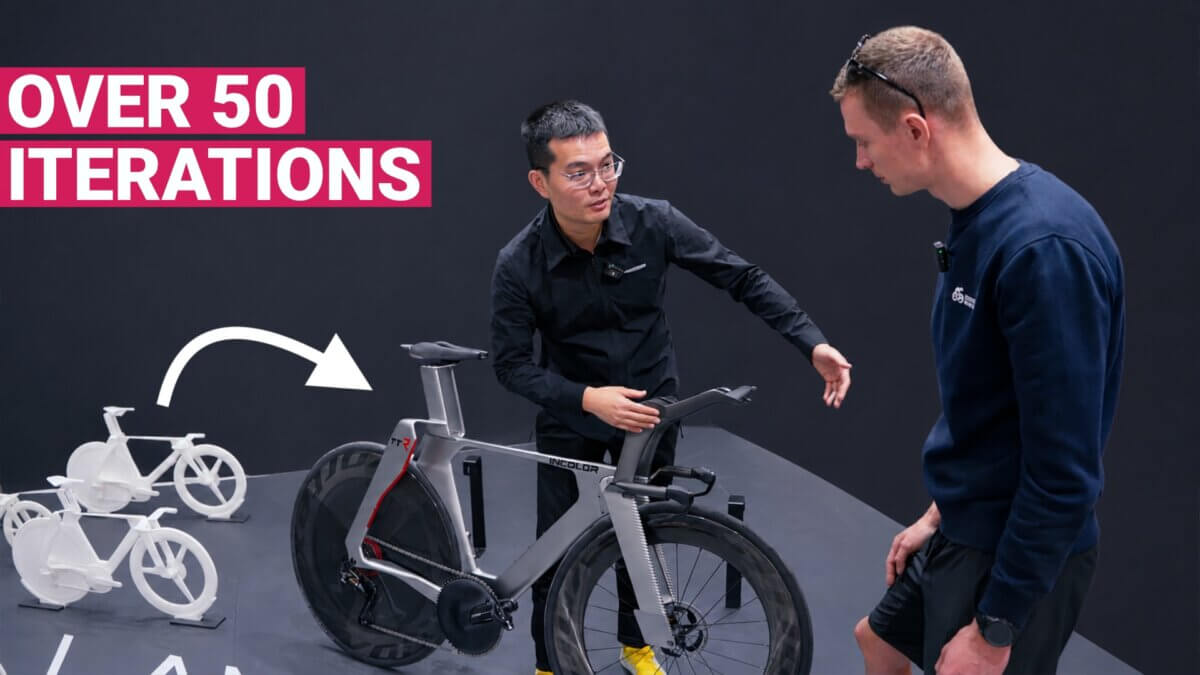
- Design Process: Developing a new Incolor frame takes about a year from concept to production, a timeline heavily driven by extensive Computational Fluid Dynamics (CFD) that included testing over 50 shapes for the concept TT bike alone.
- Voyager Gravel Bike: Blending 45mm tire clearance with road-bike handling, this versatile model is positioned as an all-around road bike built for gravel rather than a hardcore racer, fitting the Chinese definition of gravel while international riders might view it as an endurance road bike.
- SSR Aero Bike: This standout model minimizes frontal area using a thin head tube, 3D-printed titanium parts, an integrated seatpost, and custom aero bottles that save 5 to 8 watts, ultimately outperforming a Cervelo S5 by 1.8 watts in Silverstone wind tunnel testing.
- TTR Concept TT Bike: Targeting a late-year production release with 18 watts saved during development, this triathlon-focused (and potentially UCI-illegal) bike features a textured wave fork, a chainring cover, a gapped seatpost, and wide stays optimized for rider leg aerodynamics.
The through line is Incolor leaning hard on CFD and small aero details, then backing it up with 3D-printed titanium and custom parts. I also grabbed a quick ride on the SSR at the show. Watch the full interview below.
