
On this page, I explain how I score cycling shoes so you get a better idea of the details. Each category’s results contribute to my overall verdict on the shoe’s quality, which looks as follows:
Road cycling shoes:
Comfort 5/5 | Fastening 1/5 | Weight 3/5 | Design 3/5 | Price 4/5 | WEIGHTED OVERALL SCORE 3.2/5
Mountain and gravel bike shoes:
Comfort 5/5 | Walkability 3/5 | Durability 3/5 | Weight 4/5 | Price 2/5 | WEIGHTED OVERALL SCORE 3.5/5
Scores 1–2.5 are RED, 2.6–3.9 are ORANGE, and 4–5 are GREEN.
I score the following criteria on a scale mainly based on in-depth market research, which includes evaluating my and other owners’ experiences and comparing the shoes’ features with competing alternatives. The scores are weighted, meaning each feature has a different importance. For example, the ease of clip-in is more important than the adjustability.
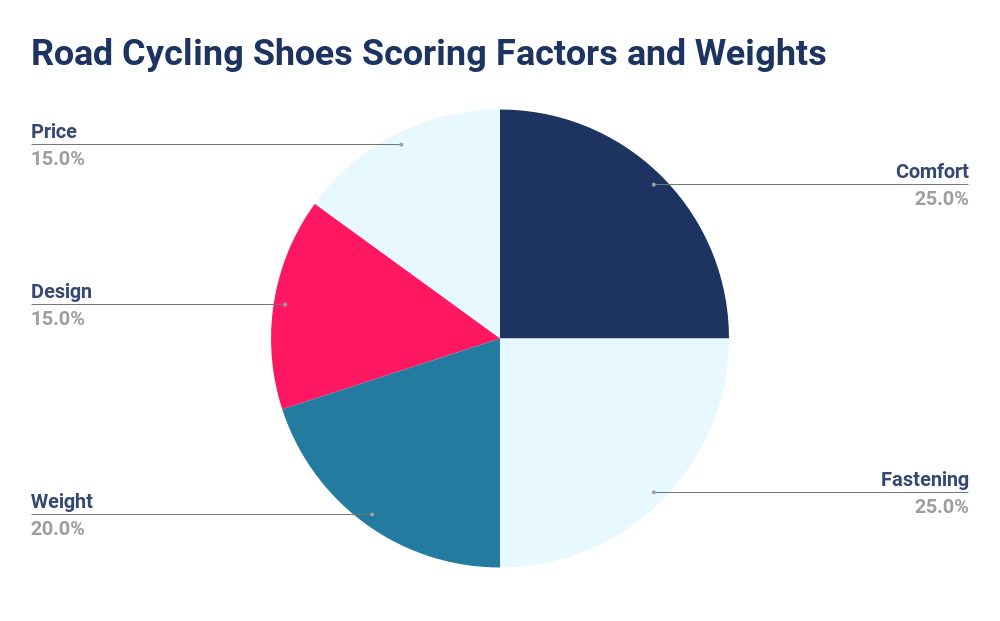
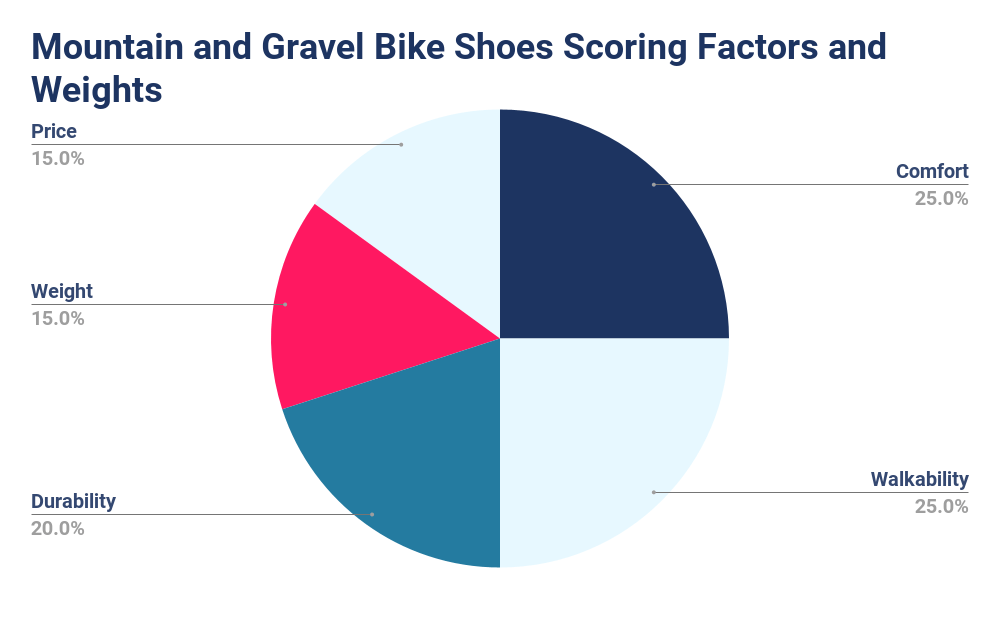
I approach each cycling shoe as objectively as possible. However, like everyone, I am subject to biases and expectations.
Scoring Criteria for Cycling Shoe Features
Below is the list of the features of bicycle shoes with an explanation of the scoring.
Comfort
Comfort includes the shoe’s shape (mainly width), padding, ventilation, eventually adjustability of the retention system, straps, etc. It’s subjective, as each of us may be comfortable with a different shoe shape. However, some manufacturers go for comfort by, for example, providing better ventilation by perforating the upper or having air vents in the sole. As for other examples, Sidi is known for having shoes with adjustable heel caps, Bont for barefoot-like shoes, and some cycling shoes are also heat moldable.
- 1 – E.g., uncomfortable shoe
- 2
- 3
- 4
- 5 – E.g., a very comfortable shoe
Fastening (Road Cycling Shoes Only)
Cycling shoes use various fastening systems, from traditional laces to a combination of velcro and buckle to BOA dials and their alternatives (Sidi Tecno Push). The different systems have their advantages and disadvantages. For example, laces allow precise tightening but cannot be adjusted on the fly and take longer to tighten. On the other hand, BOA and similar are considered the most convenient and fastest tightening methods but are prone to damage when crashing.
- 1 – E.g., shoes with 3 velcro straps or laces
- 2
- 3
- 4
- 5 – E.g., shoes with 2 BOA dials or their alternative
Walkability (Mountain and Gravel Bike Shoes Only)
The walkability combines two indicators. The first is the overall stiffness of the shoe, which is useful for energy transfer when pedaling but counterproductive when walking. Softer shoes are more suitable for walking but less suitable for pedaling efficiency.
The second is traction. MTB shoes for flat pedals have flat soles for good grip on platforms, but this is disadvantageous for walking on more challenging terrain (mud, slippery grass, gravel, etc.). Therefore, it is important to choose the right type of shoe for your preferred riding style.
- 1 – E.g., shoes are too stiff to walk in and offer almost low traction.
- 2
- 3
- 4
- 5 – E.g., shoes are easy to walk in and have high traction.
Durability (Mountain and Gravel Bike Shoes Only)
In terms of durability, I look primarily at the materials used, whether the toe is reinforced, and the type of the fastening. Mountain biking shoes need to be more robust than road cycling shoes due to contact with rocks, branches, etc. Hence their higher weight, by the way.
- 1 – E.g., shoes are too stiff to walk in and offer almost low traction.
- 2
- 3
- 4
- 5 – E.g., shoes are easy to walk in and have high traction.
Weight
When riding a bicycle, we repeat the same movement thousands of times. Therefore, the lighter the shoes, the easier the pedaling and the more enjoyable the overall experience. Of course, the weight of the shoes varies depending on their size. Some manufacturers list the weight for a smaller size to make it look like their shoes are lighter than the competition. At the same time, the weight is often given for only one shoe. The scale below, however, calculates the weight of the shoes per pair (without cases).
Due to the different nature of road and mountain shoes, I’ve broken the evaluation down into specific types.
Road cycling shoes:
- 1 – Above 600g
- 2 – [550–599g)
- 3 – [500–549g)
- 4 – [450–499g)
- 5 – Below 450g
Mountain and gravel bike shoes:
- 1 – Above 999g
- 2 – [900–999g)
- 3 – [800–899g)
- 4 – [700–799g)
- 5 – Below 700g
Design (Road Cycling Shoes Only)
The shoe design is purely subjective, so it has a low weight in the overall scoring. I mainly evaluate the overall design and the range of colors available. I like simple, minimalistic design.
- 1
- 2
- 3
- 4
- 5
Price
Shoes prices vary substantially. Higher price usually means better brand recognition and prestige, quality of workmanship, higher stiffness, better ventilation and materials, and, eventually, lower weight. Some cycling shoes also have extra features, such as customizing the shape with heat molding and using more expensive materials such as carbon or kangaroo leather.
Expensive shoes won’t make you a better cyclist, but they can give you better riding comfort. That’s why I recommend you consider your budget and think about whether you really need a pair of $500 cycling shoes.
- 1 – Above $400
- 2 – Between $300 and $399
- 3 – Between $200 and $299
- 4 – Between $100 and $199
- 5 – Below $100
Conclusion
I hope you now have a better idea of how I review cycling shoes. I aim to communicate my experience to potential buyers and help you make educated buying decisions.
Please remember that I am still tweaking and improving this process to provide you with the most valuable information possible.
I am open to feedback on how to improve this system. Feel free to contact me with suggestions.
Recent Updates
- Jan 31, 2024: V1.0 testing procedure introduced.