


Cyclists Hub is supported by its readers. We may receive a commission if you buy products using our links. All content on Cyclists Hub is written by humans, not robots. Learn More
This article compares the weights and features of the two high-end electronic road bike groupsets: Shimano Dura-Ace Di2 and SRAM RED AXS. I recently tried SRAM’s RED AXS and compared my experience with Shimano Di2. I’ll share my insights with you in this article.
KEY TAKEAWAY
Price aside, both groupsets perform well and are suitable for demanding roadies. Based on reviews, SRAM RED 2024 has matched Shimano Dura-Ace Di2 in the most crucial aspect, shifting (especially the front derailleur). RED 2024 also added “hidden” buttons (like D-Fly on Di2). SRAM is also more intuitive, offers better cross-groupset compatibility, and is completely wireless.
If you are an enthusiast with money to spend who races, you can’t go wrong with any of these groupsets. However, I recommend trying them both and forming your opinion on which suits you better.
Below, I’ll discuss key factors such as shifting, braking, ergonomics, and more to help you decide between the two groupsets.
Abbreviations used: FD – front derailleur, RD – rear derailleur
Shimano Dura-Ace Di2 vs. SRAM RED AXS: Summary
The following table summarizes the most important features of these two groupsets.
| Feature | Shimano Dura-Ace Di2 | SRAM RED AXS |
|---|---|---|
| Speeds | 12 | 12 |
| Rim brake | Yes | No |
| Disc brake | Yes | Yes |
| Shifting | Semi-wireless | Wireless |
| Power meter crankset available | Yes | Yes |
| Programmable buttons | Yes | Yes |
| Satellite shifters compatibility | Yes | Yes |
| Actual groupset weight | ~2508g | ~2566g |
| Launched | August 2021 | February 2024 |
| Price | ~$4500 | ~$4100¹ |
| Buy | Buy Dura-Ace | Buy RED |
¹Hammerhead Karoo 3 bike computer included
Updated on February 24, 2026
Pros and Cons
Let’s now take a look at their pros and cons.
| Groupset | Pros | Cons |
|---|---|---|
| Shimano Dura-Ace Di2 | • More reliable | • More expensive • Less user-friendly smartphone app that offers less insights • Semi-wireless • Worse compatibility of components between groupsets |
| SRAM RED AXS | • Fully wireless • More user-friendly smartphone app that offers more insights • Better compatibility of components between groupsets • Native, single-sided power meter | • Less reliable (occasional FD tweaks needed) |
Updated on February 24, 2026
Weight
The Shimano Dura-Ace Di2 (R9250) weighs approximately 2508g (including electrical wires and small parts). When the SRAM RED 2024 was launched, SRAM claimed it’s the lightest road groupset. However, the reality is different—it weighs around 2566g, depending on the specifications.
The Shimano power meter adds about 70g, and the SRAM power meter adds about 40g. Below are the actual weights (without a power meter) combined from multiple sources.
| Component | Dura-Ace Di2 (R9200) | SRAM RED (2024) | Difference |
|---|---|---|---|
| Shifting/brake levers | 372 | 404 | -32 |
| Crankset¹ | 685² | 551³ | 134 |
| Front derailleur | 94 | 144 | -50 |
| Rear derailleur | 217 | 285 | -68 |
| Chain | 248 | 249 | -1 |
| Cassette | 255⁴ | 232⁵ | 23 |
| Battery | 52 | 50 | 2 |
| Disc brake calipers | 290 | 314 | -24 |
| Disc brake rotors | 204 | 264 | -60 |
| Bottom bracket | 69 | 73 | -4 |
| Wires | 15 | n/a | 15 |
| Total | ~2501g | ~2566g | ~-65g |
¹Without power meter, ²52-36T (172.5mm), ³48-35T (170 mm), ⁴11-34T, ⁵10-36T
Data sources: Cache, R2-Bike, BikeRadar, Klein Concept
Winner: Shimano
Shifting
Shifting is the most critical function of cycling groupsets. The first distinction lies in the shifting system. Shimano Di2 features two buttons on each lever. The left lever controls the front derailleur, and the right lever operates the rear derailleur. Dura-Ace Di2 also includes one hidden button on the top of each lever (unlike Shimano 105 Di2).
You might also be interested in this comparison of Shimano Dura-Ace vs. Ultegra vs. 105 Di2.
SRAM takes a different approach to shifting, making it more straightforward. Each shifter has only one button. To shift the front derailleur, you press both buttons simultaneously. Shifting the rear gears involves pressing either the left or right button. The 2024 version also has “bonus” buttons, which are programmable, so you can use them like D-Fly buttons on Dura-Ace.
Each groupset has its fans. I suggest trying both to see which one suits you better. Personally, I’m used to Shimano, but I find SRAM to be more intuitive.

Let’s turn our attention to shifting speed for a moment. Both groups perform comparably in this regard. SRAM 2019 front derailleur shifting proved less reliable, but SRAM 2024 reviews suggest it now matches Shimano.
While both groupsets shift fast and reliably under load with no meaningful performance difference, Di2’s legacy smoothness and quieter operation give it a subtle edge in refinement. You can think of it as a seamless chain glide versus RED’s more pronounced click and sprocket settling feel, especially noticeable in the 10T gear.
Winner: It’s a draw
Electronics
A significant difference between Dura-Ace Di2 and RED AXS lies in their wiring: Dura-Ace Di2 is semi-wireless, while RED AXS is entirely wireless.
Dura-Ace cables run from the hidden battery (usually inside the seatpost) to the front and rear derailleurs. No cables connect the shift levers to the battery; instead, they use a CR1632 battery. This is a difference from older generations that had wired shifters.
On the other hand, SRAM’s system is fully wireless. The shifters and the front and rear derailleurs have their own batteries. The battery between derailleurs is even swappable and compatible with other SRAM road groupsets like Force or Rival. So if your RD battery dies, you can use the FD battery (which usually lasts longer because you shift the front derailleur less often).
The wireless groupset provides one more advantage, particularly for those who want to build their own bike. The installation becomes much easier because you don’t have to wire the battery to the derailleurs.
Winner: SRAM
Gear Range
We’ve been used to “standard” gears on road bikes for a long time. However, as the picture below shows, SRAM has changed the game with its X-range gearing.
In fact, it was designed so you don’t need to shift the front chainring as often. SRAM achieved this by making the cassette smaller while increasing its gear range.

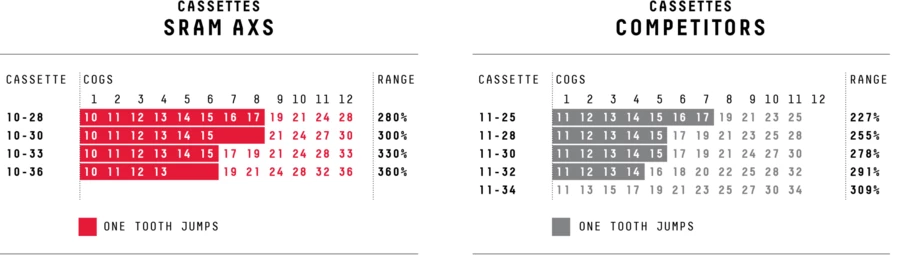
To give you a complete overview, here’s a table displaying the available chainring and cassette options:
| SRAM (X-Range) | Shimano (traditional, road) | |
|---|---|---|
| Chainrings | 50/37, 48/35, 46/33T | 53/39, 52/36, 50/34T |
| Cassettes | 10-26, 10-28, 10-33, 10-36T | 11-23, 11-25, 11-28, 11-30, 11-32, 11-34, 11-36T |
On the road, this means that RED’s 10T cog plus wide‑range cassette gives you a harder gear for faster descents and an easier gear for very steep climbs, at the cost of slightly bigger cadence gaps between gears.
Dura-Ace Di2’s 11T cog and tighter cassette options keep cadence changes smaller, which some riders prefer for fast group rides or racing on rolling terrain.
In summary, the Dura-Ace cassette range is very limited, while RED offers more options, making SRAM the go-to choice for people who want a 1X setup without sacrificing gear range.
Winner: SRAM
Design
The overall design impacts functionality and aerodynamics, but I’ll leave that discussion to engineers. I’ll focus solely on appearance. Personally, I like RED more. Dura-Ace looks good, too, but I think the previous generations were sleeker. Which one do you prefer?

RED looks a bit more sophisticated, but it’s more challenging to clean than Dura-Ace.
Winner: It’s a draw
Ergonomics
Ergonomics is crucial to me. Having shifters that fit comfortably in my hands during long rides helps prevent discomfort (and potential blisters) and enhances the overall riding experience.
The SRAM RED 2019 had pretty bulky levers, but the SRAM RED 2024 ones are a bit longer and less bulky, allowing you to rest your wrists better. I still prefer Dura-Ace shifters, but this is really a matter of preference.
Also, Shimano’s hidden buttons are located on the top of the hoods, but some people prefer SRAM’s buttons on the inside of the hoods. You really need to try both to see which position suits you better.
Winner: It’s a draw
Braking
The braking experience is quite similar for both groupsets, unlike mountain bike groupsets, where the braking effect varies slightly.
Shimano Dura-Ace Di2’s Servo-Wave tech delivers excellent modulation for precise speed control on long descents. 2024 SRAM RED’s redesigned levers, outboard pistons, and stiffer calipers have closed the gap, making the feel equally progressive and powerful.
In wet conditions, both perform confidently with minimal squeal or fade (assuming discs and braking pads are clean). RED’s improved pad clearance and rotor venting eliminate old scraping issues.
Winner: It’s a draw
Compatibility and Future Upgrades
Remember that Shimano and SRAM cassettes are no longer compatible. Most wheelsets use the Shimano-compatible HG freehubs, while SRAM uses XDR freehubs. SRAM RED AXS requires an XDR freehub. That may mean buying a new freehub body or, in some cases, a new rear wheel before you can use the full range of cassettes SRAM offers.
Frame-wise, RED’s fully wireless layout is a big win for older frames or bikes with awkward internal routing. There are no wires to thread through the frame, which makes home builds and cockpit changes much easier. Shimano Dura-Ace Di2 uses a central battery and wiring between the derailleurs, so it works best on frames with decent access ports.
When it comes to mixing in gravel or MTB parts, RED AXS has the clear edge. You can pair it with XPLR or even Eagle rear derailleurs and wide-range cassettes if you want truly low gearing for steep off-road climbs or bikepacking. Shimano Dura-Ace Di2 can be combined with GRX for a more “gravelish” setup, but you have fewer extreme gearing options, and you have to compromise a bit if you want one bike to handle everything from fast road to rough gravel.
Winner: SRAM
Extras
Satellite shifters are valuable accessories for climbers or time trialists, as they eliminate the need to move your hand to change gears. Unlike the Shimano 105 Di2, the Shimano Dura-Ace Di2 supports satellite shifters because it has an accessory port. SRAM RED also supports satellite shifters, but they are wireless, making the installation more convenient.
Both groupsets are available with a power meter. However, Shimano power meters, unlike Quarq power meters found on SRAM groupsets, don’t have the best reputation. For this reason, I recommend using one of these reliable power meters with the Shimano groupset.
Both groupsets also have Bluetooth and smartphone connectivity. However, SRAM’s smartphone app is more user-friendly and delivers more information than Shimano’s. As a result, if you’re interested in tracking miles per gear or want to quickly reconfigure the buttons, SRAM is the better choice.
Winner: SRAM
Price
SRAM has a cost advantage. The Shimano Dura-Ace R9250 is priced at $4500 (excluding a power meter). At this price range, you can buy a pretty good road bike.
While the previous SRAM RED AXS was available for around $2400, the 2024 version costs ~$4100 without a power meter and ~$4600 with one. However, it also includes a Hammerhead Karoo 3 bike computer, which costs $499 on its own. That’s a significant price bump.
Winner: SRAM
Total Score: Shimano (1), SRAM (4), It’s a draw (4)
Who Should Choose Which?
SRAM RED AXS 2024 has effectively matched Shimano Dura-Ace Di2 in front derailleur shifting reliability and overall value, with advantages in full wireless simplicity and broader gearing options.
The choice ultimately boils down to your riding style and priorities, and whether you want to leave the Shimano HG ecosystem. For gran fondos, adventure crossovers, or tech-forward setups, RED AXS pulls ahead with 1X options that offer a greater gear range (though with large jumps between them), and superior data tracking, all while matching Di2’s speed under load.
Test both if you can, as shifter ergonomics and tactile feedback are deeply personal. Objectively, RED AXS 2024 offers better value for most riders today, but Dura-Ace endures for those chasing ultimate refinement.
Which of these two groupsets appeals to you more? Do you prefer Shimano or SRAM? Let me know in the comments.

There is rim brake option for SRAM Red AXS.
https://www.bike24.com/p2316535.html
Oh, I missed that. Corrected! Thank you.
– Petr
As a new SRAM Red user (formerly Shimano), I am fully satisfied with their groupset. I definitely noticed that I don’t need to shift the front derailleur as often, which is very pleasant. So that’s a big plus for me.
The intuitive system with left and right is a lot of fun for me. It’s like a video game. Pew pew. It’s just so enjoyable, and the groupset is configured to change the front derailleur automatically. It just works very well. I haven’t had a single issue with it yet.
Hi Marco,
Thank you for sharing your experience. 🙂
– Petr