


Cyclists Hub is supported by its readers. We may receive a commission if you buy products using our links. All content on Cyclists Hub is written by humans, not robots. Learn More
This article compares the weights and features of two mid-range electronic road bike groupsets: Shimano Ultegra Di2 and SRAM Force AXS. As a dedicated Shimano Di2 user, I recently tried SRAM Force AXS. I’m excited to share my experience with you. Below, I discuss key factors like shifting performance, ergonomics, customization, and overall value. These points will help you decide between the two groupsets.
KEY TAKEAWAY
Both groupsets are great choices, offering top-notch performance and reliability. However, the best one for you ultimately depends on your unique needs, preferences, and budget. The main difference is that Force is wireless, making it easier to install when building your bike. It also offers a better built-in power meter. Ultegra, on the other hand, offers more reliable front derailleur shifting, including under load.
To ensure you make the most informed decision, I highly recommend giving both groupsets a test ride before committing to one. Alternatively, you can order Shimano Ultegra and SRAM Force using the links below.
Abbreviations used: FD – front derailleur, RD – rear derailleur
Shimano Ultegra Di2 vs. SRAM Force AXS: Summary
The following table summarizes the most important features of these two groupsets.
| Feature | Shimano Ultegra Di2 | SRAM Force AXS |
|---|---|---|
| Speeds | 12 | 12 |
| Rim brake | Yes | No |
| Disc brake | Yes | Yes |
| Shifting | Semi-wireless | Wireless |
| Power meter crankset available | Yes | Yes |
| Satellite shifters compatibility | Yes | Yes¹ |
| Groupset weight | ~2776g | ~2782g |
| Launched | August 2021 | June 2025 |
| Price | ~$2500 | ~$2500 |
| Buy | Buy Ultegra | Buy Force |
¹You can use wireless satellite shifters.
Pros and Cons
Let’s now take a look at their pros and cons.
| Groupset | Pros | Cons |
|---|---|---|
| Shimano Ultegra Di2 | • More reliable • Better shifting (especially front derailleur) | • More expensive • Less user-friendly smartphone app that offers less insights • Semi-wireless • Worse compatibility of components between groupsets |
| SRAM Force AXS | • Fully wireless • More user-friendly smartphone app that offers more insights • Better compatibility of components between groupsets • Native, single-sided power meter | • Less reliable (occasional FD tweaks needed) • Worse front derailleur shifting |
Updated on February 24, 2026
Weight
The Shimano Ultegra Di2 electronic groupset is heavier than its mechanical predecessor (R8000). The R8000 groupset weighs around 2503g (about 200g less than the mechanical Shimano 105 R7020), while the R8100 weighs about 2776g. The wireless SRAM Force AXS groupset weighs 2782g.
| Component | Shimano Ultegra Di2 (R8100) | SRAM Force | Difference |
|---|---|---|---|
| Shifting/brake levers | 385 | 394 | -9 |
| Crankset¹ | 749 | 708 | 41 |
| Front derailleur | 111 | 151 | -40 |
| Rear derailleur | 260 | 285 | -25 |
| Chain | 263 | 242 | 21 |
| Cassette | 342 | 273 | 69 |
| Battery | 52 | 50 | 2 |
| Disc brake calipers | 327 | 286 | 41 |
| Disc brake rotors | 196 | 320 | -124 |
| Bottom bracket | 76 | 73 | 3 |
| Wires | 15 | 0 | 15 |
| Total | ~2776g | ~2782g | ~-6g |
¹Without power meter, ²52-36T (172.5mm), ³46-33 teeth (170mm), ⁴11-34T, ⁵10-33T
Data sources: Cache, R2-Bike, BikeRadar, road.cc
Winner: It’s a draw
Shifting
Shifting is the most critical function of cycling groupsets, and it’s also where these two groupsets differ the most.
The first difference is in the shifting system. Shimano Di2 has two buttons on both levers. The left lever shifts the front derailleur, and the right lever shifts the rear derailleur. Ultegra also has one hidden button in each lever (unlike Shimano 105 Di2).
TIP: Check out this comparison of Shimano 105 vs. Ultegra vs. Dura-Ace Di2.
SRAM approaches shifting differently. It is simpler. Each shifter has only one button. To shift the front derailleur, you press both buttons at once. Shifting the rear gears is done by pressing the left or right button.

Each groupset has its advocates. I encourage you to try out both to determine which one is a better fit for you. Personally, I’m more familiar with Shimano, but I find SRAM quite user-friendly.
Now, let’s discuss shifting speed for a moment. Both groups perform similarly in this aspect. SRAM has faced criticism for its front derailleur shifting, which isn’t as precise, seamless, and reliable as Shimano’s.
On the other hand, SRAM Force boasts better chain management. The rear derailleur’s spring maintains chain tension, preventing chain slap when riding bumpy roads or cobblestones.
Winner: Shimano
Electronics
A notable distinction between Ultegra Di2 and Force AXS is that Ultegra Di2 is semi-wireless, while Force AXS is completely wireless.
With Ultegra, cables connect the battery (concealed in the seatpost) to the front and rear derailleurs. There are no cables between the shift levers and the battery since they are integrated into the levers.
TIP: You might be interested in this comparison between SRAM and Shimano.
In contrast, SRAM’s system is fully wireless. The shifters and front and rear derailleurs each have their own batteries, which can be swapped between the front and rear derailleurs as necessary. These batteries are compatible with all SRAM road groupsets.
The wireless groupset offers an advantage, especially for those building their own bike, since installation is simpler. You only need to route the brake cables through the frame.
Winner: SRAM
Gear Range
We’ve grown accustomed to “traditional” gears on road bikes for many years. However, SRAM has revolutionized gearing with its X-range system, as shown in the image below.
The design aims to reduce the need for frequent front chainring shifts. SRAM accomplished this by downsizing the chainring while expanding the cassette’s gear range.

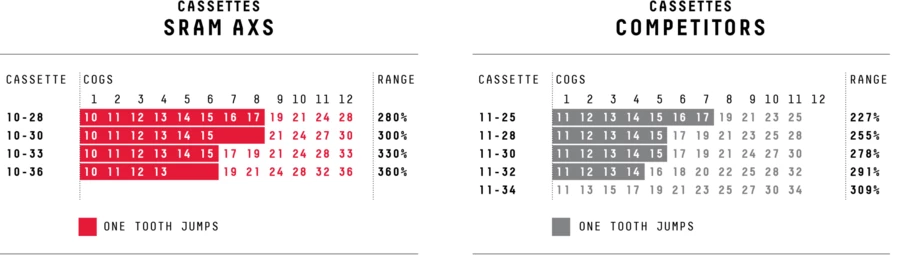
For reference, here are the available chainring and cassette options:
| SRAM (X-Range) | Shimano (traditional, road) | |
|---|---|---|
| Chainrings | 50/37, 48/35, 46/33T | 53/39, 52/36, 50/34T |
| Cassettes | 10-26, 10-28, 10-33, 10-36T | 11-23, 11-25, 11-28, 11-30, 11-32, 11-34, 11-36T |
On the road, this means that Force’s 10T cog plus wide‑range cassette gives you a harder gear for faster descents and an easier gear for very steep climbs, at the cost of slightly bigger cadence gaps between gears.
Ultegra Di2’s 11T cog and tighter cassette options keep cadence changes smaller, which some riders prefer for fast group rides or racing on rolling terrain.
Winner: SRAM
Design
The overall design influences functionality and aerodynamics, but I’ll leave this topic to engineers and evaluate the looks alone.
Personally, I’m more drawn to Shimano’s design. The previous generation of the SRAM Force was not very appealing, so SRAM also focused on it. They completely redesigned the front chainrings.

Force looks a bit cooler now, but it will probably be a bit more challenging to clean than Ultegra.
Winner: It’s a draw
Ergonomics
Ergonomics is essential to me. Having shifters that fit comfortably in my hands during long rides helps prevent discomfort (eventually, which eventually causes blisters) and enhances the overall riding experience.
Previous generations of SRAM Force had bulky levers, but the latest ones are now slimmer. While Force remains somewhat bulkier than Ultegra, both fit well in the hands.
Winner: It’s a draw
Braking
The braking experience is quite similar for both groupsets, unlike mountain bike groupsets, where braking modulation varies slightly.
Unfortunately, I haven’t had the chance to test both sets side by side, and I haven’t found a comprehensive braking test.
However, we can reasonably expect similar performance based on the Shimano 105 Di2 and SRAM Rival AXS results.
Winner: It’s a draw
Compatibility and Future Upgrades
Remember that Shimano and SRAM cassettes are no longer compatible. Most wheelsets use the Shimano-compatible HG freehubs, while SRAM uses XDR freehubs. SRAM Force AXS normally expects an XDR freehub. That may mean buying a new freehub body or, in some cases, a new rear wheel to run the full range of cassettes SRAM offers.
Frame-wise, Force’s fully wireless layout is a big win for older frames or bikes with awkward internal routing. There are no wires to thread through the frame, which makes home builds and cockpit changes much easier. Shimano Ultegra Di2 uses a central battery and wiring between the derailleurs, so it works best on frames with decent access ports.
When it comes to mixing in gravel or MTB parts, Force AXS has the clear edge. You can pair it with XPLR or even Eagle rear derailleurs and wide-range cassettes if you want truly low gearing for steep off-road climbs or bikepacking. Shimano Ultegra Di2 can be combined with GRX for a more “gravelish” setup, but you have fewer extreme gearing options and must compromise if you want one bike to cover everything from fast road to chunky gravel.
Winner: SRAM
Extras
Satellite shifters are a valuable accessory for climbers or time trialists, as they eliminate the need to move your hand to change gears. Shimano Ultegra Di2 supports them (unlike Shimano 105 Di2) because it has an accessory port. SRAM Force lacks this port, but you can still connect wireless satellite shifters to the system.
Both groupsets offer Bluetooth and smartphone connectivity. However, SRAM’s smartphone app is more user-friendly and delivers more information than Shimano’s. As a result, if you’re interested in tracking miles per gear or want to quickly reconfigure the buttons, SRAM is the better choice.
Both groupsets also come with a power meter. However, Shimano power meters don’t have the best reputation, unlike those from Quarq and SRAM. For that reason, I recommend pairing the Shimano groupset with one of these proven power meters instead.
Winner: SRAM
Price
Price-wise, SRAM has an advantage. The Shimano Ultegra R8100 is priced at around $2500 (excluding a power meter).
Meanwhile, the SRAM Force AXS has maintained a relatively consistent price, costing only about $2100.
This makes Force a more affordable option than Ultegra, even with a power meter and satellite shifters added.
Winner: SRAM
Total Score: Shimano (1), SRAM (5), It’s a draw (4)
Who Should Choose Which?
Because the price difference between Ultegra and Force is smaller than between 105 and Rival, making a final decision is more challenging. Although SRAM scores higher points in my comparison, the smaller price gap may not be enough to convince you of Force’s better value.
Shimano Ultegra Di2 suits climbers or crit racers who prioritize crisper front shifts under load and tighter gear spacing to maintain a smooth cadence on rolling terrain or during repeated attacks. Its semi-wireless setup feels more “road race refined,” but requires frame routing.
Or for reliability-focused road purists who value longer intervals between charges (typically 1-3 months) and compatibility with common HG freehub wheels.
SRAM Force AXS suits endurance riders, bikepackers, or gravel-adjacent folks who want a wider gear range (10T cog + XPLR/Eagle cassettes) and 1x simplicity for loaded tours or mixed-surface adventures. It’s a fully wireless setup that shines for easier DIY installs.
Or for performance tinkerers wanting an integrated power meter and app-based tweaks out of the box. It requires more frequent dual-battery charges (every 1–2 months).
Which of these two groupsets appeals to you more? If you could try both, which would you choose? Let me know in the comments.

Na alles gelezen te hebben zou ik persoonlijk opteren voor Sram Force . Beide zijn volgens mij even goed ( Shimano / Scram ) . Reden is : prijsverschil , volledig draadloos en gebruiksvriendelijker .Ikzelf sta op punt nieuwe racefiets aan te schaffen en ben niets anders gewoon dan Campagnolo ( mechanische Chorus) waar ik zeer tevreden over ben en mee vertrouwd ben . Hoe zit het eigelijk met Campagnolo ? Niemand raad mij dat nog aan en uiten hun voorkeur naar shimano of sram …campagnolo verdween zowat op de achtergrond …wat ik bertreur ! Qua looks is er niks mooier dan Campa , enige nadeel is dat het duurder is maar toch volgens mij duurzamer dan Shimano…maar dat is natuurlijk een persoonlijke keuze ,smaak …
.
Hi Gino,
I would say that Campagnolo is becoming obsolete. You can watch my video of my first impressions from thier latest groupset. Basically, they are the most expensive while not offering any competitive advantage.
– Petr