
On this page, I explain how I score road bikes so you get a better idea of the details. Each category’s results contribute to my overall verdict on the road bike’s quality, which looks as follows:
Weight 2/5 | Comfort 3/5 | Aerodynamics 3/5 | Components 4/5 | Build Quality 3/5 | Design 3/5 | Brand Recognition 3/5 | WEIGHTED OVERALL SCORE 3.0/5
Scores 1–2.5 are RED, 2.6–3.9 are ORANGE, and 4–5 are GREEN.
I score the following criteria on a scale from 1-5 based on in-depth market research, which includes evaluating my and other owners’ experiences and comparing the bike’s components with competing alternatives. The scores are weighted, meaning each feature has a different importance. For example, the handling is more important than the design.
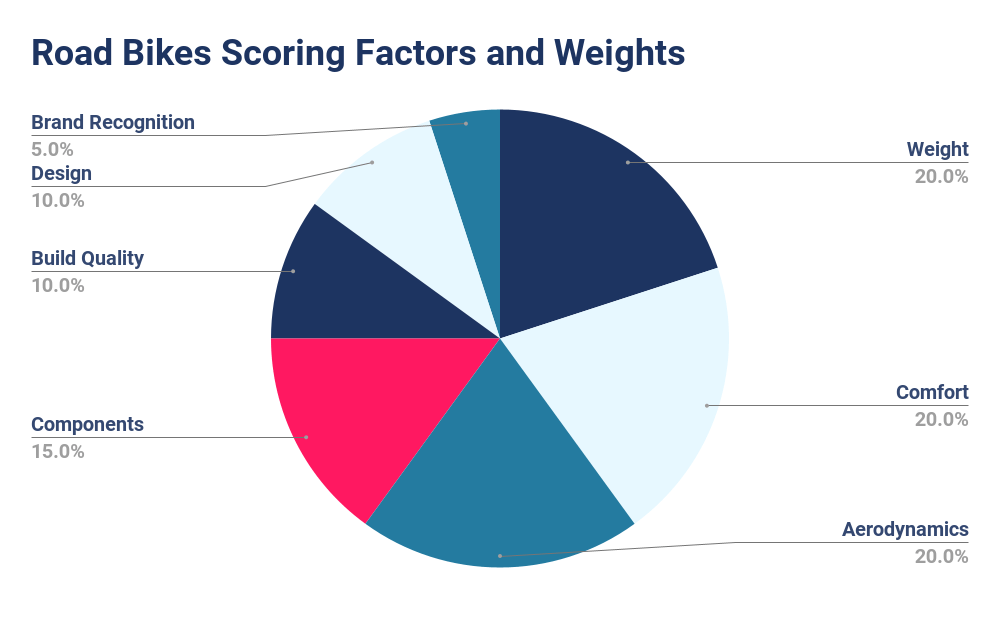
I approach each bike as objectively as possible. However, like everyone, I am subject to biases and expectations.
Scoring Criteria for Road Bike Features
Below is the list of the features of road bikes with an explanation of the scoring.
Overall Weight
Nobody likes heavy bikes. That’s why the overall weight is part of this scoring as well. The scoring is stricter than my hybrid or gravel bike scoring because weight is more important for roadies. This range applies to all price categories.
- 1 – 10 kg and more
- 2 – [9–10 kg)
- 3 – [8–9 kg)
- 4 – [7–8 kg)
- 5 – Below 7 kg
Comfort
Riding comfort on road bikes is mainly influenced by geometry, stiffness, and tire width. Road bikes with upright geometry, also called endurance road bikes, are suitable for more casual riders and those who don’t care about aerodynamics. Bikes with performance or racing geometry require more flexibility.
Stiffness is difficult to measure without expensive equipment, but the general rule is that carbon bikes with thicker tubes (mostly aero road bikes) are stiffer than aluminum bikes. However, manufacturers aim to balance stiffness and comfort for the best riding characteristics.
The last factor affecting comfort is the tire width. Today’s road bikes come with 25, 28, or 30mm tires. However, you might also find bikes with 32mm or even wider tires. Those are almost like gravel bikes
- 1 – E.g., the bike is overly stiff, has a performance geometry and narrow tires.
- 2
- 3
- 4
- 5 – E.g., the bike has an endurance geometry, tires wider than 28mm, and is not overly stiff.
Aerodynamics
Aerodynamics is difficult to measure without standardized testing and expensive equipment. But, it’s possible to guess to a certain extent the level of aerodynamics based on a few features. For example, it’s known that external cable routing adds drag. On the other hand, deep-section wheels and tubes reduce it.
Some frames (Specialized SL8) are surprisingly aero despite their thin tubes in the rear end. That’s because the front end (where aero matters the most) is well-designed.
- 1 – E.g., the bike has shallow wheels, external routing, and thin tubes.
- 2
- 3
- 4
- 5 – E.g., the bike has internal cable routing, deep section wheels, and an aero frame.
Components
When it comes to components, I mainly look at what components the road bike is equipped with. In particular, the frame, groupset, disc vs. rim brakes, and wheels. For the frame, I look at what material it is made of and what its other characteristics are (quality of workmanship, weight, etc.).
For a groupset, I evaluate what kind of groupset it is, whether it is mechanical or electronic, or whether it is a combination of different groupsets. I simplify the evaluation of the wheels to whether they are aluminum or carbon and what reviews are available about them.
I evaluate the components in the context of the price category of the bike. I.e., a $5000 bike may have components rated 3, just like a $1000 bike.
- 1 – E.g., the bike has low-quality components.
- 2
- 3
- 4
- 5 – E.g., the bike has quality components.
Build Quality
When evaluating build quality, I look at photos of details, especially welds, as well as reviews from other customers and their longer-term experiences. For some bikes, build quality only becomes apparent in the longer term, in which case longer-term reviews and the experiences of others are irreplaceable.
- 1 – E.g., the bike has serious manufacturing defects.
- 2
- 3
- 4
- 5 – E.g., the bike is built with attention to detail.
Design
Design is highly subjective, but I have to like the bike I ride. That’s why I’ve included it to a small extent. I look primarily at how the bike feels to me as a whole, whether the manufacturer pays attention to detail, whether the cable routing is internal, etc.
- 1 – Old-looking bike without too much effort from designers.
- 2
- 3
- 4
- 5 – Modern-looking bike designed with an attention to detail.
Brand Recognition
Given the traditional nature of road cycling and the type of people it attracts, I also address brand recognition in the road bike evaluation. Whether you like it or not, to some extent, road cycling is also a status game for some people. They buy a bike based on how the brand is perceived.
Some of the top-tier cycling brands include Trek, Specialized, Scott, Canyon, Colnago and others. Polygon or Co-op, for example, are lesser known.
- 1 – E.g., the brand is only known locally.
- 2
- 3
- 4
- 5 – E.g., the brand is known worldwide.
Conclusion
I hope you now know better how I review road bikes. I aim to help buyers like you make educated buying decisions.
Please remember that I am still tweaking and improving this process to provide you with the most valuable information possible.
I am open to feedback on how to improve this system. Feel free to contact me with suggestions.
Recent Updates
- Jan 17, 2024: V1.0 scoring introduced.